Gilbert Houngbo Re-elected as Director-General of the International Labour Organization
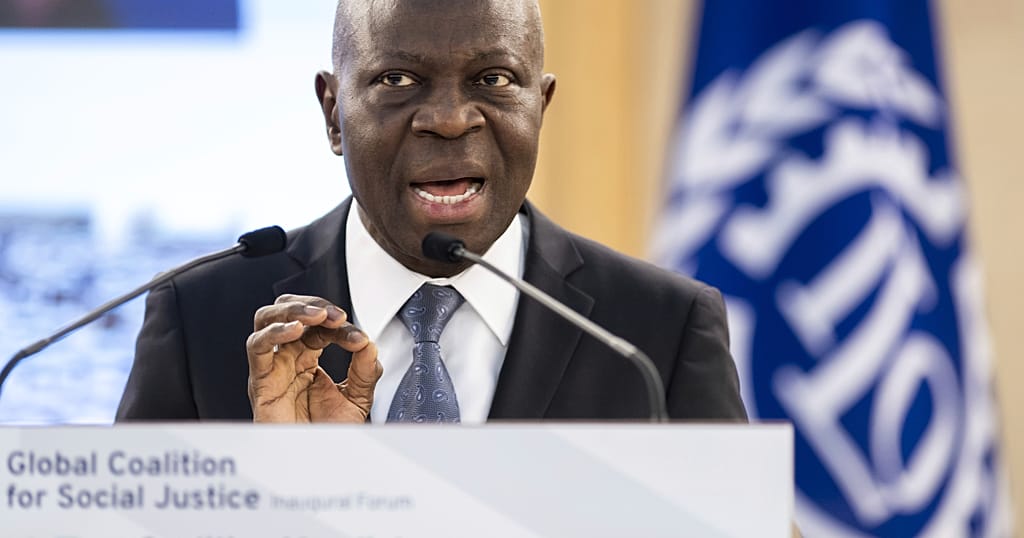
Former Togolese Prime Minister Gilbert Houngbo secured a second five-year term as head of the International Labour Organization after his final challenger withdrew.
 🌍Africa
Photo: Africanews
Key points
- Gilbert Houngbo secured a second term as ILO Director-General with 51 votes.
- Spanish Labour Minister Yolanda Diaz Perez withdrew, citing concerns over financial management.
- The agency faces significant funding challenges and the need to regulate the impact of AI on labor.
Gilbert Houngbo has been re-elected to lead the International Labour Organization (ILO) for a second five-year term, beginning October 1, 2025. The former Togolese prime minister received 51 votes from the organization's governing body in Geneva, with five abstentions recorded. His path to re-election was cleared after Spanish Labour Minister Yolanda Diaz Perez withdrew her candidacy shortly before the vote.
Diaz Perez, who cited a desire to prevent divisions within the global trade union movement, expressed sharp criticism of the current leadership. In a statement, she accused the administration of overseeing the deepest financial crisis in the organization's history, noting that funding declines—specifically from the United States—have necessitated significant institutional reforms and staff reductions.
Following his victory, Houngbo emphasized the organization's enduring commitment to social justice and human dignity. He identified the rapid advancement of artificial intelligence as a critical challenge for the agency, stating that the ILO must ensure technological progress serves humanity rather than undermining labor stability. The ILO, founded in 1919, maintains a unique tripartite structure representing governments, employers, and workers across 187 member states.
The stakes
Houngbo’s second term secures continuity for the UN agency as it navigates severe budgetary constraints and internal friction regarding its management style. The organization must now balance necessary austerity measures with its mandate to protect labor rights, while simultaneously attempting to address the disruptive influence of artificial intelligence on global employment markets.
Two readings
- Supporters view Houngbo’s re-election as a necessary consolidation of leadership required to navigate the agency through complex financial reforms and evolving global labor standards.
- Critics, including those who supported the withdrawal of alternative candidates, argue that the current leadership has failed to address systemic financial instability and has alienated segments of the global trade union movement.
Source Africanews — africanews.com/2026/11/16/gilbert-houngbo-re-elected-to-lead-un-labo… ↗
Read next
 ✒️Opinion & Analysis
ICJ Rules Myanmar Military Committed Genocide Against Rohingya
The International Court of Justice has found Myanmar's military guilty of genocide against the Rohingya, a ruling that damages the international standing of both Aung San…
 🕯️Democracy & Rights
Chinese teachers face rising parental pressure over personal life choices
Chinese educators are encountering a surge in unreasonable demands from parents, including complaints regarding teachers' pregnancy and maternity leave.
 🛡️War & Security
Ukraine Restricts Media Coverage of Infrastructure Damage Amid Russian Strikes
President Volodymyr Zelenskyy has issued a decree prohibiting media outlets from reporting on the impact of Russian strikes against critical infrastructure and the status…
 🏮China & Taiwan
Beijing Reaffirms Reunification Stance Following Taiwan Local Election Results
China’s Taiwan Affairs Office declared that the island’s reunification with the mainland remains inevitable, despite recent shifts in Taiwan's local political landscape.
 🇪🇺Europe
US Air Force Repels Unauthorized Drone Incursion at RAF Lakenheath
U.S. security forces at a British air base successfully countered a group of unidentified drones, amid growing concerns over potential foreign state involvement.
 ⚖️Law & Policy
India Government Proposes 50% Increase in Parliamentary Seats and Women's Reservation
The Indian government plans to introduce legislation to expand the Lok Sabha to 850 seats and mandate a 33% reservation for women in legislative bodies.