Pakistan President Zardari and Prime Minister Shehbaz Confer on Security and Governance
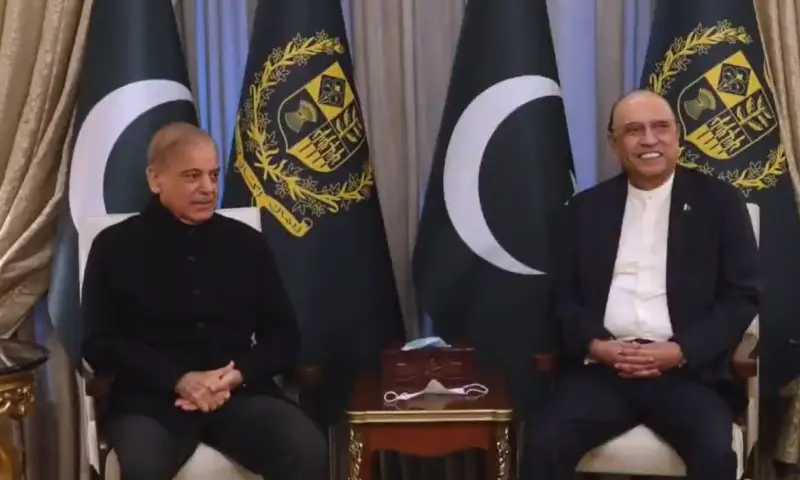
President Asif Ali Zardari and Prime Minister Shehbaz Sharif held high-level talks in Lahore covering national security, allied cooperation, and economic development.
 🌏Asia-Pacific
Photo: Dawn
Key points
- President Zardari and Prime Minister Shehbaz met in Lahore to discuss security and politics.
- The prime minister briefed the president on his recent climate conference visit to Turkiye.
- Both leaders reaffirmed their commitment to coalition cooperation and economic stability.
President Asif Ali Zardari and Prime Minister Shehbaz Sharif held a comprehensive meeting in Lahore on Saturday to review the nation's political, economic, and security landscapes, according to an official statement from the premier's office. Prime Minister Shehbaz greeted President Zardari upon his arrival at the prime minister's Model Town residence for the discussions.
During the session, the prime minister briefed the head of state on his recent trip to Turkiye, where he attended the 31st Conference of Parties to outline Pakistan's climate initiatives. The two leaders also evaluated ongoing cooperation among their governing coalition parties, discussed mechanisms for sustained political consultation, and reviewed the execution of public welfare initiatives.
Both officials underscored their shared resolve to drive forward economic stabilization programs and foster national development. The meeting follows a separate high-level engagement between President Zardari and Interior Minister Mohsin Naqvi, which had previously prompted the presidential secretariat to dismiss media speculation regarding proposed provincial boundary changes, clarifying instead that the talks focused strictly on national security.
The stakes
The ruling coalition stands to gain stability through aligned leadership, while opposition figures risk being sidelined by executive consensus; policy continuity and economic reforms hang in the balance.
Two readings
- Supporters read the meeting as a vital display of unity and effective governance necessary to tackle national security challenges and advance economic reform.
- Critics read the discussions as backroom coalition management aimed at consolidating executive power rather than addressing immediate public hardships.
Source Dawn — dawn.com/news/2044497/president-zardari-pm-shehbaz-discuss-countrys… ↗
Read next
 ✒️Opinion & Analysis
ICJ Rules Myanmar Military Committed Genocide Against Rohingya
The International Court of Justice has found Myanmar's military guilty of genocide against the Rohingya, a ruling that damages the international standing of both Aung San…
 🕯️Democracy & Rights
Chinese teachers face rising parental pressure over personal life choices
Chinese educators are encountering a surge in unreasonable demands from parents, including complaints regarding teachers' pregnancy and maternity leave.
 🛡️War & Security
Ukraine Restricts Media Coverage of Infrastructure Damage Amid Russian Strikes
President Volodymyr Zelenskyy has issued a decree prohibiting media outlets from reporting on the impact of Russian strikes against critical infrastructure and the status…
 🏮China & Taiwan
Beijing Reaffirms Reunification Stance Following Taiwan Local Election Results
China’s Taiwan Affairs Office declared that the island’s reunification with the mainland remains inevitable, despite recent shifts in Taiwan's local political landscape.
 🇪🇺Europe
US Air Force Repels Unauthorized Drone Incursion at RAF Lakenheath
U.S. security forces at a British air base successfully countered a group of unidentified drones, amid growing concerns over potential foreign state involvement.
 ⚖️Law & Policy
India Government Proposes 50% Increase in Parliamentary Seats and Women's Reservation
The Indian government plans to introduce legislation to expand the Lok Sabha to 850 seats and mandate a 33% reservation for women in legislative bodies.