Philippine Lawmaker Lordan Suan Denies Faked Parliamentary Government Remarks
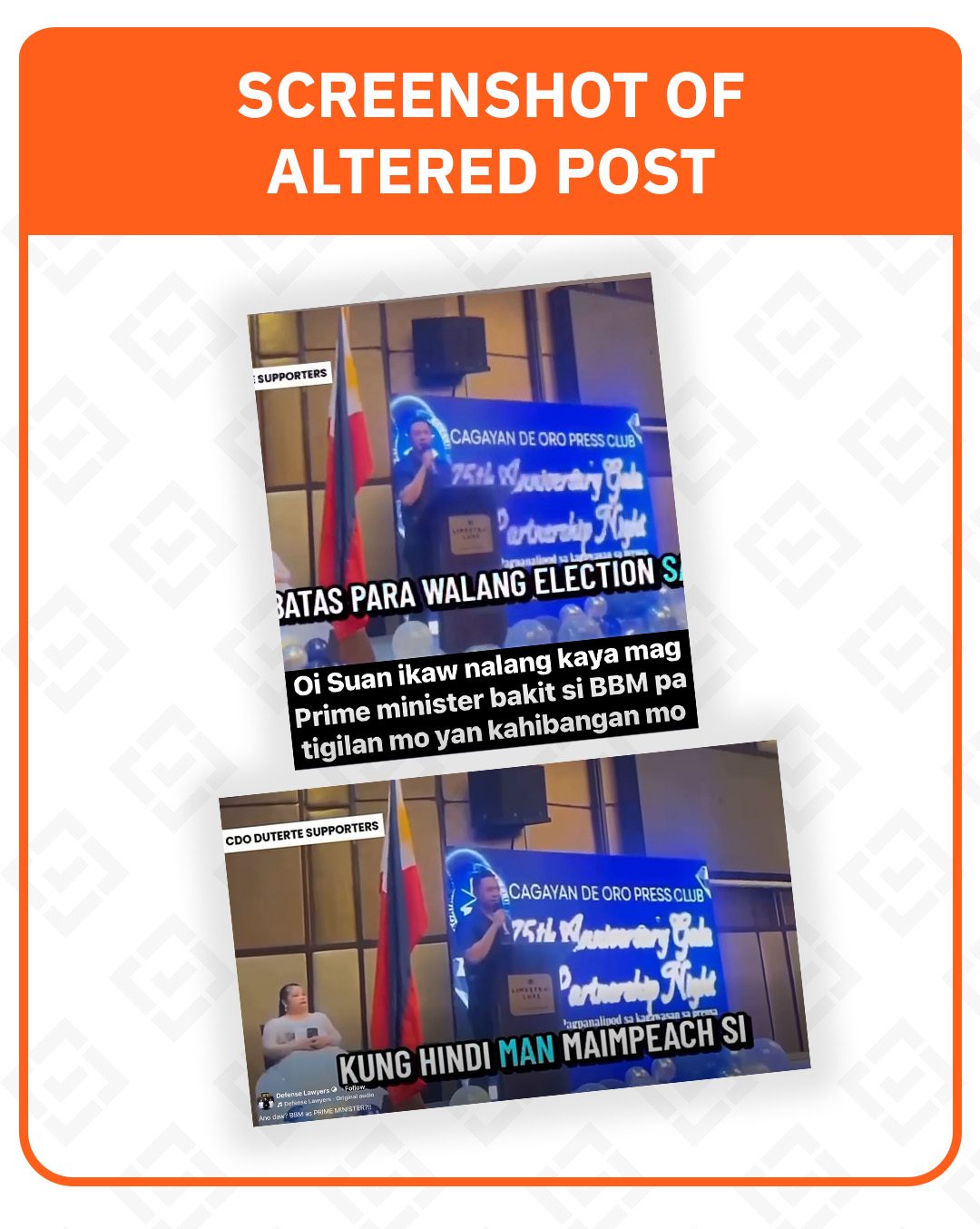
An altered video circulating online falsely attributes statements to Philippine Representative Lordan Suan regarding a proposed shift to a parliamentary system and the cancellation of the 2028 elections. Both Suan's office and local journalists have refuted the fabricated claims.
 🌏Asia-Pacific
Photo: Rappler
Key points
- Representative Lordan Suan's office denied making statements about shifting to a parliamentary government.
- An altered video from a press club event falsely claimed Suan proposed canceling the 2028 elections.
- Local journalists and the event organizers confirmed the audio was entirely fabricated.
Philippine Representative Lordan Suan did not propose transitioning the country to a parliamentary form of government with President Ferdinand Marcos Jr. as prime minister, according to fact-checkers and official clarifications. Widely shared social media posts featured an altered video clip originating from Suan's address at the Cagayan de Oro Press Club’s 75th Anniversary Gala on November 23. The manipulated audio falsely claimed that Suan suggested enacting a law to bypass the 2028 elections and alter the constitution if Vice President Sara Duterte is not impeached.
Official records and independent documentation of the four-minute speech reveal that Suan actually focused on the importance of a free press in combating misinformation and highlighted House Bill No. 9397, known as the Right to Information Act. The legislator's office formally denounced the viral material on November 27, affirming his commitment to democratic governance and the public's right to freely choose leadership. The Cagayan de Oro Press Club also issued a statement condemning the distribution of unverified and deceptive media designed to mislead citizens.
The stakes
The spread of manipulated political media undermines public trust in democratic institutions and heightens tensions between rival political factions in the Philippines. If unchecked, such disinformation campaigns risk distorting policy debates surrounding constitutional reforms and upcoming electoral cycles.
Two readings
- Supporters of the swift debunking argue that exposing forged audio is essential to safeguard democratic norms and protect elected officials from coordinated misinformation attacks.
- Critics contend that deepfakes and altered video content highlight the vulnerability of digital platforms to political manipulation, pointing to the rapid spread of inflammatory narratives before corrections can take effect.
Source Rappler — rappler.com/newsbreak/fact-check/lordan-suan-fake-audio-parliamenta… ↗
Read next
 ✒️Opinion & Analysis
ICJ Rules Myanmar Military Committed Genocide Against Rohingya
The International Court of Justice has found Myanmar's military guilty of genocide against the Rohingya, a ruling that damages the international standing of both Aung San…
 🕯️Democracy & Rights
Chinese teachers face rising parental pressure over personal life choices
Chinese educators are encountering a surge in unreasonable demands from parents, including complaints regarding teachers' pregnancy and maternity leave.
 🛡️War & Security
Ukraine Restricts Media Coverage of Infrastructure Damage Amid Russian Strikes
President Volodymyr Zelenskyy has issued a decree prohibiting media outlets from reporting on the impact of Russian strikes against critical infrastructure and the status…
 🏮China & Taiwan
Beijing Reaffirms Reunification Stance Following Taiwan Local Election Results
China’s Taiwan Affairs Office declared that the island’s reunification with the mainland remains inevitable, despite recent shifts in Taiwan's local political landscape.
 🇪🇺Europe
US Air Force Repels Unauthorized Drone Incursion at RAF Lakenheath
U.S. security forces at a British air base successfully countered a group of unidentified drones, amid growing concerns over potential foreign state involvement.
 ⚖️Law & Policy
India Government Proposes 50% Increase in Parliamentary Seats and Women's Reservation
The Indian government plans to introduce legislation to expand the Lok Sabha to 850 seats and mandate a 33% reservation for women in legislative bodies.