Sri Lanka Authorizes Pilot Testing for Chinese Autonomous Air Taxi Service
Sri Lanka has granted a license to Chinese manufacturer EHang to begin testing pilotless electric air taxis in Colombo, aiming to integrate the technology into national transport infrastructure.
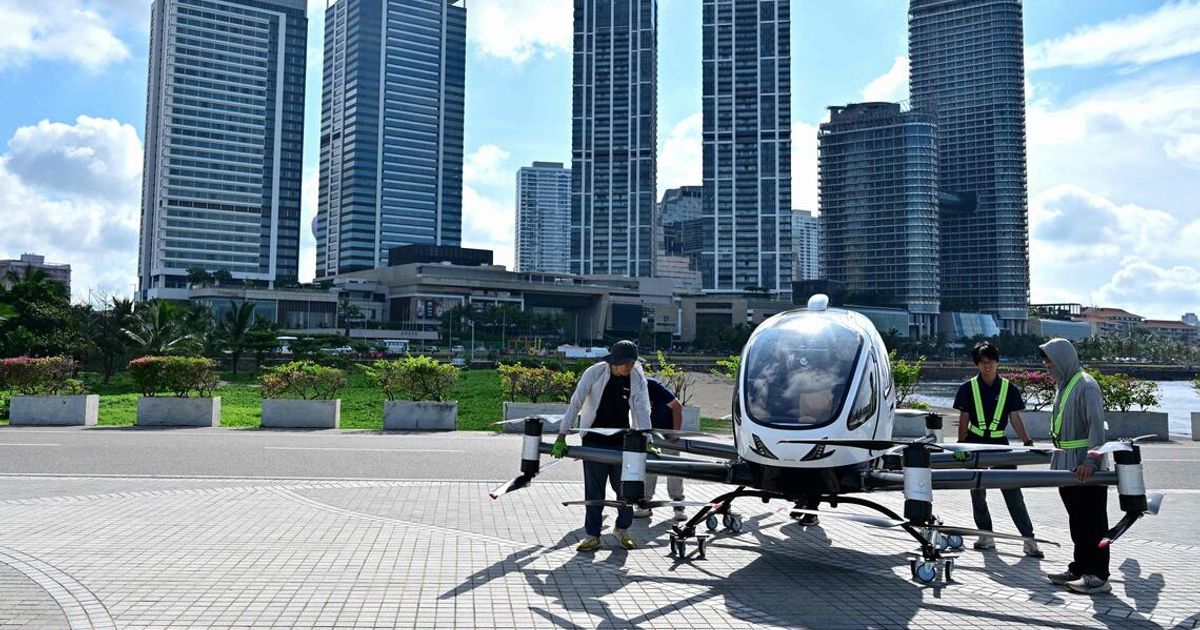 🌏Asia-Pacific
Photo: Straits Times Asia
Key points
- Sri Lanka authorizes EHang to test pilotless air taxis in Colombo.
- The EH216-S aircraft successfully completed a demonstration flight with government officials.
- Testing will continue for five months before the government considers commercial permits.
Sri Lankan authorities announced on Nov. 11 that they have officially authorized a pilot program for autonomous passenger drones. The Civil Aviation Authority granted the license to the Chinese manufacturer EHang, allowing for the testing of a two-seater, pilotless electric aircraft capable of vertical take-off and landing.
The initiative commenced with a demonstration flight in Colombo, which featured Ports and Aviation Minister Anura Karunathilaka and his deputy, Janitha Ruwan Kodithuwakku, as the first passengers. Following the flight, Minister Kodithuwakku confirmed that Sri Lanka is now participating in a global effort to adopt passenger-drone technology, joining over a dozen other nations currently exploring similar services.
Testing is expected to span approximately five months, after which the government will evaluate the feasibility of commercial operations. Officials envision using the EH216-S aircraft to establish an air-taxi link between the international airport and Colombo’s city center, a route that currently requires up to 30 minutes of travel time by road. The aircraft is powered by 16 electric motors and is designed to cover distances of up to 30 kilometers on a single charge.
The stakes
The success of this pilot program could position Sri Lanka as an early adopter of advanced urban air mobility in South Asia, potentially easing traffic congestion in the capital. However, the project depends on the successful completion of safety trials and the establishment of a robust regulatory framework for autonomous airspace management, which could either modernize local transport or stall due to safety and infrastructure concerns.
Two readings
- Supporters view the partnership with EHang as a strategic move to modernize Sri Lanka's transport infrastructure and boost the country's profile in the global tech-innovation race.
- Critics may raise questions regarding the safety of autonomous flight in densely populated urban areas and the long-term economic viability of integrating such niche technology into an already strained domestic economy.
Source Straits Times Asia — straitstimes.com/asia/south-asia/sri-lanka-launches-pilot-of-chines… ↗
Read next
 ✒️Opinion & Analysis
ICJ Rules Myanmar Military Committed Genocide Against Rohingya
The International Court of Justice has found Myanmar's military guilty of genocide against the Rohingya, a ruling that damages the international standing of both Aung San…
 🕯️Democracy & Rights
Chinese teachers face rising parental pressure over personal life choices
Chinese educators are encountering a surge in unreasonable demands from parents, including complaints regarding teachers' pregnancy and maternity leave.
 🛡️War & Security
Ukraine Restricts Media Coverage of Infrastructure Damage Amid Russian Strikes
President Volodymyr Zelenskyy has issued a decree prohibiting media outlets from reporting on the impact of Russian strikes against critical infrastructure and the status…
 🏮China & Taiwan
Beijing Reaffirms Reunification Stance Following Taiwan Local Election Results
China’s Taiwan Affairs Office declared that the island’s reunification with the mainland remains inevitable, despite recent shifts in Taiwan's local political landscape.
 🇪🇺Europe
US Air Force Repels Unauthorized Drone Incursion at RAF Lakenheath
U.S. security forces at a British air base successfully countered a group of unidentified drones, amid growing concerns over potential foreign state involvement.
 ⚖️Law & Policy
India Government Proposes 50% Increase in Parliamentary Seats and Women's Reservation
The Indian government plans to introduce legislation to expand the Lok Sabha to 850 seats and mandate a 33% reservation for women in legislative bodies.