Rethinking U.S.-China Strategic Stability Through the Lens of Status Recognition
As U.S. and Chinese leadership prepare for a new summit, experts suggest that addressing Beijing's 'status deficit' may be more effective than traditional coercive diplomacy.
 🏮China & Taiwan
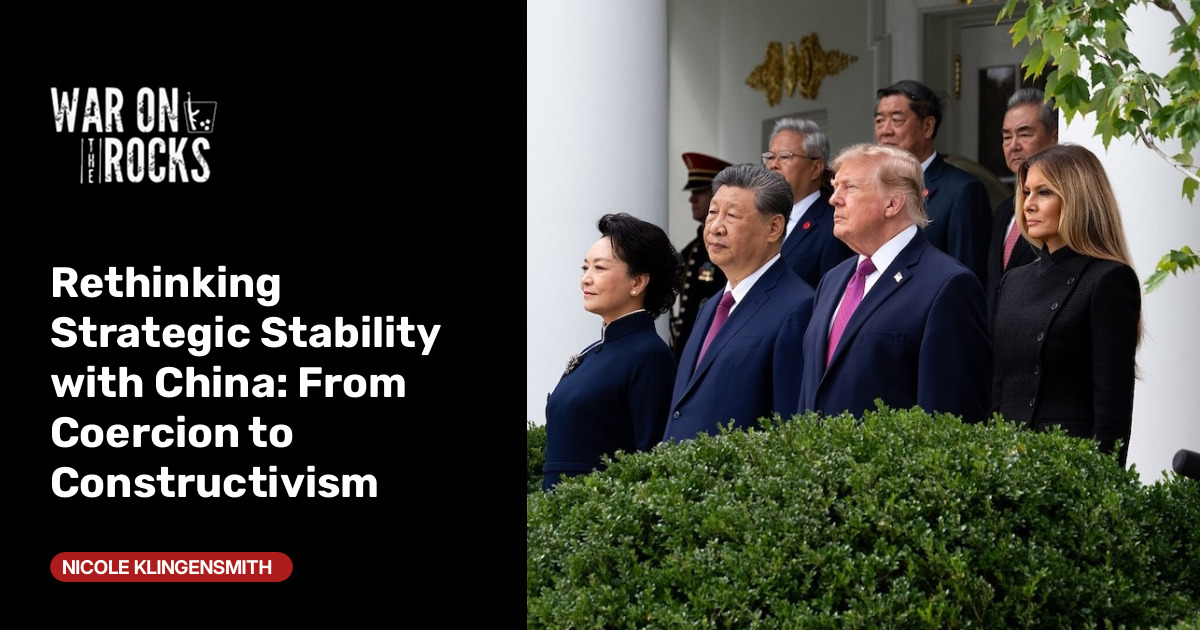
Photo: War on the Rocks
Key points
- Traditional coercive diplomacy has failed to achieve strategic stability with China.
- China's foreign policy is heavily influenced by a perceived 'status deficit' and historical grievances.
- Future negotiations may benefit from addressing Beijing's demand for equal status in the global hierarchy.
Decades of U.S. foreign policy aimed at integrating China into the international order have yielded limited results, as traditional containment and coercive strategies fail to curb Beijing's rapid nuclear expansion. Analysts argue that a shift in perspective is required, focusing on the concept of 'status recognition'—the social validation of a state's identity and position within the global hierarchy. By examining China’s internal motivations rather than relying solely on external pressure, policymakers may find new pathways to negotiate strategic stability.
Central to this approach is the understanding that China perceives a significant 'status deficit' compared to the United States. This dissatisfaction, rooted in a historical narrative of grievance and a desire for national rejuvenation, drives Beijing's current behavior. Under the leadership of General Secretary Xi Jinping, China has consistently emphasized themes of equality and respect in international forums, including recent BRICS summits and high-level meetings with U.S. leadership. These signals reflect a demand for deference that aligns with China's self-perception as a global leader.
The upcoming summit between President Donald Trump and General Secretary Xi Jinping offers a critical opportunity to test whether status-informed diplomacy can succeed where previous efforts have stalled. By acknowledging China's desire for parity and addressing the psychological components of its national identity, the U.S. might move beyond the current deadlock in arms control and security cooperation.
The stakes
If this diplomatic pivot succeeds, it could lead to a more stable, predictable relationship between the two superpowers, potentially slowing the nuclear arms race. Failure to address these status concerns, however, risks further entrenching the current adversarial dynamic, leaving the international system vulnerable to continued escalation and the potential for miscalculation in security policy.
Two readings
- Supporters argue that recognizing China's status aspirations provides a necessary, non-coercive framework to bring Beijing to the negotiating table for meaningful arms control.
- Critics contend that validating China’s self-perception risks rewarding authoritarian revisionism and undermines the existing international rules-based order.
Source War on the Rocks — warontherocks.com/rethinking-strategic-stability-with-china-from-coerci… ↗
Read next
 ✒️Opinion & Analysis
ICJ Rules Myanmar Military Committed Genocide Against Rohingya
The International Court of Justice has found Myanmar's military guilty of genocide against the Rohingya, a ruling that damages the international standing of both Aung San…
 🕯️Democracy & Rights
Chinese teachers face rising parental pressure over personal life choices
Chinese educators are encountering a surge in unreasonable demands from parents, including complaints regarding teachers' pregnancy and maternity leave.
 🛡️War & Security
Ukraine Restricts Media Coverage of Infrastructure Damage Amid Russian Strikes
President Volodymyr Zelenskyy has issued a decree prohibiting media outlets from reporting on the impact of Russian strikes against critical infrastructure and the status…
 🇪🇺Europe
US Air Force Repels Unauthorized Drone Incursion at RAF Lakenheath
U.S. security forces at a British air base successfully countered a group of unidentified drones, amid growing concerns over potential foreign state involvement.
 ⚖️Law & Policy
India Government Proposes 50% Increase in Parliamentary Seats and Women's Reservation
The Indian government plans to introduce legislation to expand the Lok Sabha to 850 seats and mandate a 33% reservation for women in legislative bodies.
 ⚖️Law & Policy
India’s ruling alliance nears two-thirds majority for sweeping parliamentary expansion and delimitation bills
The National Democratic Alliance is nearing a two-thirds majority in Parliament to pass landmark legislation expanding the Lok Sabha by 50 percent and implementing a 33 p…