Mahmood Khan Achakzai Proposes National Government to Resolve Pakistan's Political Crisis
The Tehreek-i-Tahafuz-i-Ayin-i-Pakistan (TTAP) has advocated for a national government to address Pakistan's ongoing constitutional instability, though the proposal faces internal opposition from the PTI.
 🕯️Democracy & Rights
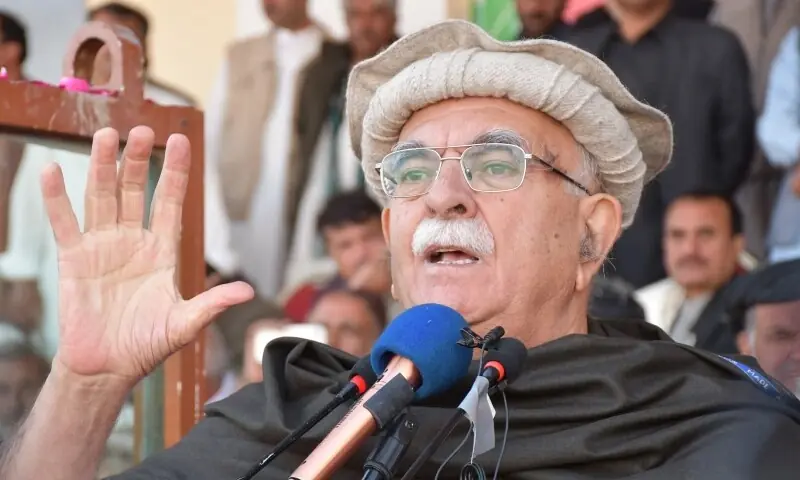
Photo: Dawn
Key points
- TTAP proposes a national government to address Pakistan's political instability.
- The PTI has largely rejected the proposal following internal party deliberations.
- The plan calls for reforms to the Election Commission and a focus on fundamental rights.
The Tehreek-i-Tahafuz-i-Ayin-i-Pakistan (TTAP) has formally proposed the establishment of a national government as the primary mechanism to resolve Pakistan's deepening political and constitutional crisis. TTAP Chairman and National Assembly Opposition Leader Mahmood Khan Achakzai argues that comprehensive reforms are necessary to stabilize the nation, suggesting that such a government could facilitate the release of imprisoned former Prime Minister Imran Khan and restore public trust in democratic institutions.
Despite the proposal's intent to foster national consensus, it has encountered significant resistance within the Pakistan Tehreek-i-Insaf (PTI). Internal discussions among PTI parliamentary members revealed that a majority of the party remains skeptical of the plan, effectively distancing themselves from Achakzai's initiative. TTAP spokesperson Akhunzada Hussain Ahmed Yousafzai emphasized that any such arrangement must be reached through transparent, multi-party dialogue rather than backroom negotiations, warning that excluding key political stakeholders would erode the government's democratic legitimacy.
The TTAP framework calls for a multi-party conference to initiate the process, prioritizing the protection of fundamental rights and political freedoms. Furthermore, the proposal advocates for the appointment of a non-partisan Chief Election Commissioner to ensure the independence of the Election Commission of Pakistan. The stated goal is to create a neutral environment capable of conducting transparent general elections that accurately reflect the public mandate.
The stakes
If adopted, this proposal would shift the current power structure toward a temporary, consensus-based administration, potentially easing the imprisonment of high-profile political figures. However, failure to secure broad support from major parties like the PTI risks further deepening political polarization and leaving the constitutional impasse unresolved.
Two readings
- Supporters view the national government as a necessary reset to restore constitutional order, protect civil liberties, and end the cycle of political victimization.
- Critics argue that such an arrangement lacks a clear democratic mandate and fear it could be used to manipulate political outcomes or bypass established electoral processes.
Source Dawn — dawn.com/news/2047240/achakzais-proposal-of-national-govt-only-solu… ↗
Read next
 ✒️Opinion & Analysis
ICJ Rules Myanmar Military Committed Genocide Against Rohingya
The International Court of Justice has found Myanmar's military guilty of genocide against the Rohingya, a ruling that damages the international standing of both Aung San…
 🛡️War & Security
Ukraine Restricts Media Coverage of Infrastructure Damage Amid Russian Strikes
President Volodymyr Zelenskyy has issued a decree prohibiting media outlets from reporting on the impact of Russian strikes against critical infrastructure and the status…
 🏮China & Taiwan
Beijing Reaffirms Reunification Stance Following Taiwan Local Election Results
China’s Taiwan Affairs Office declared that the island’s reunification with the mainland remains inevitable, despite recent shifts in Taiwan's local political landscape.
 🇪🇺Europe
US Air Force Repels Unauthorized Drone Incursion at RAF Lakenheath
U.S. security forces at a British air base successfully countered a group of unidentified drones, amid growing concerns over potential foreign state involvement.
 ⚖️Law & Policy
India Government Proposes 50% Increase in Parliamentary Seats and Women's Reservation
The Indian government plans to introduce legislation to expand the Lok Sabha to 850 seats and mandate a 33% reservation for women in legislative bodies.
 ⚖️Law & Policy
India’s ruling alliance nears two-thirds majority for sweeping parliamentary expansion and delimitation bills
The National Democratic Alliance is nearing a two-thirds majority in Parliament to pass landmark legislation expanding the Lok Sabha by 50 percent and implementing a 33 p…