Pope Leo XIV Urges Unity and Social Advocacy During Argentina Visit
Pope Leo XIV called on the Argentine Catholic Church to bridge internal divisions and prioritize the needs of the impoverished during a visit to Buenos Aires. The pontiff also invoked the legacy of figures associated with the nation's struggle for human rights.
 🕯️Democracy & Rights
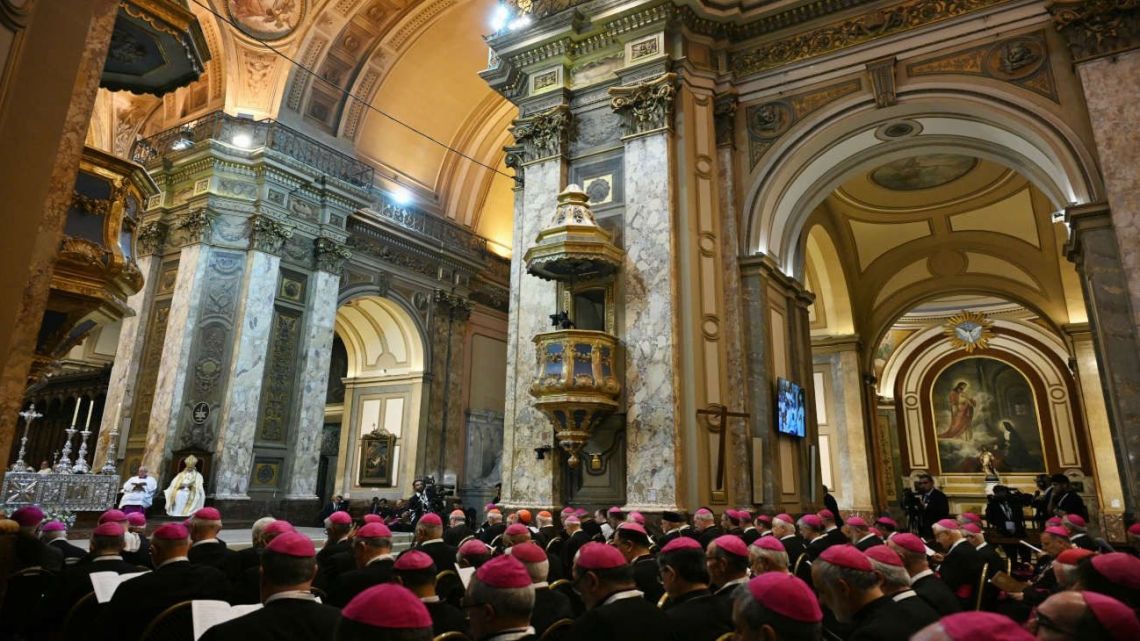
Photo: Buenos Aires Times
Key points
- Pope Leo XIV calls for unity and social support for the poor in Argentina.
- The pontiff honored Bishop Enrique Angelelli, a victim of the 1976 military dictatorship.
- The address emphasizes the Church's role in addressing modern economic challenges like unemployment.
During a service at the Buenos Aires Metropolitan Cathedral, Pope Leo XIV issued a call for the Argentine Catholic Church to embrace diversity while maintaining unity. Addressing the nation's bishops, the pontiff emphasized the necessity of supporting those suffering from poverty, housing insecurity, and unemployment. This visit, which also included tributes to his predecessor Pope Francis, served as a platform for the Pope to encourage a more collaborative and attentive approach to the challenges facing contemporary Argentine society.
The Pope’s homily highlighted the regional diversity of Argentina, framing it as a strength that should be unified through faith and ecclesial communion. He explicitly urged the clergy to foster fraternity and welcome legitimate differences, suggesting that such internal harmony is essential for the Church to effectively serve the public. By calling for a "preferential option for the poor," the pontiff reaffirmed a core tenet of his predecessor's pastoral mission.
In a move widely interpreted as a political signal, the Pope referenced the legacy of Bishop Enrique Angelelli, who was murdered during Argentina’s military dictatorship in 1976. By honoring Angelelli alongside other figures who worked for peace, the pontiff underscored the Church's historical role in confronting state-sponsored violence. The message served as a reminder of the Church's responsibility to advocate for justice and human rights in the face of historical and modern-day societal fractures.
The stakes
The Pope’s intervention places pressure on the Argentine Church to act as a cohesive mediator in a country often polarized by economic instability and political friction. By aligning the institution with the needs of the vulnerable, the leadership risks alienating factions that prefer a less activist role, while simultaneously attempting to consolidate its influence as a moral authority in national policy.
Two readings
- Supporters view the Pope’s message as a necessary moral compass that encourages the Church to remain relevant by addressing systemic inequality and historical trauma.
- Critics may perceive the inclusion of politically charged historical references as an overreach that risks entangling the Church in secular political disputes.
Source Buenos Aires Times — batimes.com.ar/news/argentina/pope-leo-urges-argentinaschurch-to-he… ↗
Read next
 ✒️Opinion & Analysis
ICJ Rules Myanmar Military Committed Genocide Against Rohingya
The International Court of Justice has found Myanmar's military guilty of genocide against the Rohingya, a ruling that damages the international standing of both Aung San…
 🛡️War & Security
Ukraine Restricts Media Coverage of Infrastructure Damage Amid Russian Strikes
President Volodymyr Zelenskyy has issued a decree prohibiting media outlets from reporting on the impact of Russian strikes against critical infrastructure and the status…
 🏮China & Taiwan
Beijing Reaffirms Reunification Stance Following Taiwan Local Election Results
China’s Taiwan Affairs Office declared that the island’s reunification with the mainland remains inevitable, despite recent shifts in Taiwan's local political landscape.
 🇪🇺Europe
US Air Force Repels Unauthorized Drone Incursion at RAF Lakenheath
U.S. security forces at a British air base successfully countered a group of unidentified drones, amid growing concerns over potential foreign state involvement.
 ⚖️Law & Policy
India Government Proposes 50% Increase in Parliamentary Seats and Women's Reservation
The Indian government plans to introduce legislation to expand the Lok Sabha to 850 seats and mandate a 33% reservation for women in legislative bodies.
 ⚖️Law & Policy
India’s ruling alliance nears two-thirds majority for sweeping parliamentary expansion and delimitation bills
The National Democratic Alliance is nearing a two-thirds majority in Parliament to pass landmark legislation expanding the Lok Sabha by 50 percent and implementing a 33 p…