Turkish Protesters Rally in Istanbul Against Government Crackdown on Opposition Media
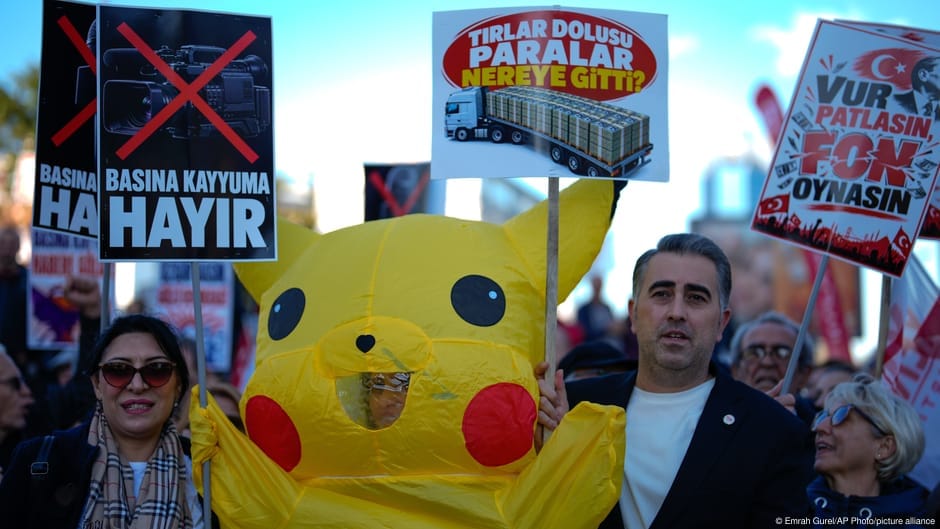
Thousands of demonstrators marched in Istanbul to protest the state-led seizure of opposition media outlets and the imprisonment of journalists.
 🇪🇺Europe
Photo: DW English
Key points
- Thousands protested in Istanbul against the closure of Sozcu TV and other opposition outlets.
- The Turkish government has installed trustees at several major media companies, effectively placing them under state control.
- Turkey is currently ranked 163rd in the world for press freedom, with 25 journalists currently behind bars.
Thousands of demonstrators marched through Istanbul on Sunday to protest the Turkish government's recent closure of several opposition-aligned media outlets and the arrest of senior journalists. The rally, organized by the main opposition party, Yeni Parti, followed a police raid on Sozcu TV, one of the country's last remaining independent television channels.
During the raid on Sozcu TV, authorities arrested senior staff members and installed a government-appointed trustee to manage the company. This move places the broadcaster under compulsory state administration, a tactic that has been applied to other major outlets over the past year. Similar takeovers have recently targeted Tele1, the digital news site T24, and Halk TV, which previously held the position of the most-watched news channel in Turkey.
The crackdown occurs amidst a broader period of pressure on the Turkish press, characterized by digital censorship and frequent prosecutions. In the last two months, several reporters were detained for investigating a multi-billion dollar investment fund scandal, with at least two remaining in pretrial detention. According to the Media and Law Studies Association (MLSA), there are currently 25 journalists imprisoned in the country.
Reporters Without Borders currently ranks Turkey 163rd out of 180 nations in its annual Press Freedom Index. Despite the legal risks, some journalists, including those from the shuttered Halk TV, have announced plans to continue their work via alternative digital platforms to circumvent state control, emphasizing that the press cannot be silenced by administrative takeovers.
The stakes
The Turkish administration gains a more controlled information environment by neutralizing platforms that highlight government scandals or opposition viewpoints. Conversely, the Turkish public loses access to independent oversight, and the country faces potential international friction as its standing on global human rights and press freedom indices continues to decline.
Two readings
- Supporters of the government view these interventions as legitimate law enforcement actions against media organizations that allegedly spread misinformation and threaten national stability.
- Critics interpret the raids and trustee appointments as a systematic campaign to silence dissent and ensure the ruling party maintains a monopoly on the national narrative.
Source DW English — dw.com/en/turkey-thousands-protest-closure-of-critical-media-outlet… ↗
Read next
 ✒️Opinion & Analysis
ICJ Rules Myanmar Military Committed Genocide Against Rohingya
The International Court of Justice has found Myanmar's military guilty of genocide against the Rohingya, a ruling that damages the international standing of both Aung San…
 🕯️Democracy & Rights
Chinese teachers face rising parental pressure over personal life choices
Chinese educators are encountering a surge in unreasonable demands from parents, including complaints regarding teachers' pregnancy and maternity leave.
 🛡️War & Security
Ukraine Restricts Media Coverage of Infrastructure Damage Amid Russian Strikes
President Volodymyr Zelenskyy has issued a decree prohibiting media outlets from reporting on the impact of Russian strikes against critical infrastructure and the status…
 🏮China & Taiwan
Beijing Reaffirms Reunification Stance Following Taiwan Local Election Results
China’s Taiwan Affairs Office declared that the island’s reunification with the mainland remains inevitable, despite recent shifts in Taiwan's local political landscape.
 ⚖️Law & Policy
India Government Proposes 50% Increase in Parliamentary Seats and Women's Reservation
The Indian government plans to introduce legislation to expand the Lok Sabha to 850 seats and mandate a 33% reservation for women in legislative bodies.
 ⚖️Law & Policy
India’s ruling alliance nears two-thirds majority for sweeping parliamentary expansion and delimitation bills
The National Democratic Alliance is nearing a two-thirds majority in Parliament to pass landmark legislation expanding the Lok Sabha by 50 percent and implementing a 33 p…