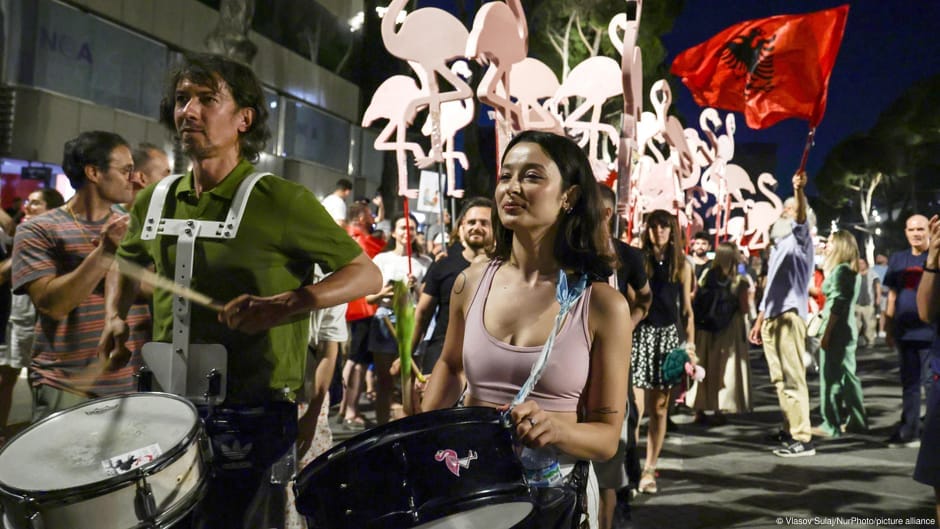
Albanian Youth Demand Political Reform in Growing 'Flamingo Revolution' Protests
Student-led protests in Albania have escalated into a broader movement against government corruption, demanding the resignation of Prime Minister Edi Rama and systemic electoral reform.
 🇪🇺Europe
Photo: DW English
Key points
- Protesters demand the resignation of Prime Minister Edi Rama and systemic electoral reform.
- The movement emerged from opposition to coastal development and evolved into widespread anti-corruption demonstrations.
- Albania's electoral system is criticized for concentrating power in the hands of party leaders.
A wave of civil unrest known as the "Flamingo Revolution" has gripped Albania, as young demonstrators increasingly reject the country's entrenched political establishment. The movement, which originated in May over concerns regarding coastal development projects involving high-profile international figures, has expanded into a nationwide demand for accountability, targeting Prime Minister Edi Rama and the long-standing political class.
Protesters argue that despite economic growth and a thriving tourism sector under Rama’s administration, prosperity remains concentrated among a small, well-connected elite. Demonstrators point to widespread corruption, including charges against former government deputies, as evidence of a system that prioritizes private interests over public services like healthcare and education. The frustration is further fueled by an electoral system established in 2008, which critics claim empowers party leaders at the expense of constituent representation and makes it difficult for new political parties to gain traction.
The situation reached a flashpoint on October 13, when student-led demonstrations at the Education Ministry turned violent, resulting in clashes with police, mass arrests, and the use of tear gas and water cannons. While the Prime Minister has dismissed the unrest as the result of "foreign hands" and insisted that political change must occur exclusively through the ballot box, protesters continue to call for his resignation and the formation of a transitional government.
The stakes
The outcome of these protests will determine whether Albania can break its cycle of personality-driven politics dominated by the same figures for over two decades. If the movement forces concessions, it could lead to significant electoral reform and a shift toward more transparent governance; if it fails, the country risks further democratic backsliding and continued mass emigration of its youth.
Two readings
- Supporters view the movement as a necessary democratic awakening, arguing that the current political duopoly has failed to provide equal opportunity or fair representation.
- Critics and government officials characterize the protests as an destabilizing attempt to bypass legitimate democratic processes and undermine the rule of law through street-level pressure.
Source DW English — dw.com/en/albania-s-youth-are-protesting-in-flamingo-revolution-not… ↗
Read next
 ✒️Opinion & Analysis
ICJ Rules Myanmar Military Committed Genocide Against Rohingya
The International Court of Justice has found Myanmar's military guilty of genocide against the Rohingya, a ruling that damages the international standing of both Aung San…
 🕯️Democracy & Rights
Chinese teachers face rising parental pressure over personal life choices
Chinese educators are encountering a surge in unreasonable demands from parents, including complaints regarding teachers' pregnancy and maternity leave.
 🛡️War & Security
Ukraine Restricts Media Coverage of Infrastructure Damage Amid Russian Strikes
President Volodymyr Zelenskyy has issued a decree prohibiting media outlets from reporting on the impact of Russian strikes against critical infrastructure and the status…
 🏮China & Taiwan
Beijing Reaffirms Reunification Stance Following Taiwan Local Election Results
China’s Taiwan Affairs Office declared that the island’s reunification with the mainland remains inevitable, despite recent shifts in Taiwan's local political landscape.
 ⚖️Law & Policy
India Government Proposes 50% Increase in Parliamentary Seats and Women's Reservation
The Indian government plans to introduce legislation to expand the Lok Sabha to 850 seats and mandate a 33% reservation for women in legislative bodies.
 ⚖️Law & Policy
India’s ruling alliance nears two-thirds majority for sweeping parliamentary expansion and delimitation bills
The National Democratic Alliance is nearing a two-thirds majority in Parliament to pass landmark legislation expanding the Lok Sabha by 50 percent and implementing a 33 p…