BSW Party Rejects Formal Ban on Cooperation with Far-Right AfD
The BSW party has voted against a motion to strictly prohibit cooperation with the far-right Alternative for Germany (AfD), sparking internal dissent.
 🇪🇺Europe
Photo: DW English
Key points
- BSW delegates rejected a motion to strictly ban cooperation with the AfD.
- Party leadership favors a flexible approach allowing joint voting on specific issues.
- Internal opposition warns that the strategy risks legitimizing a party classified as extremist.
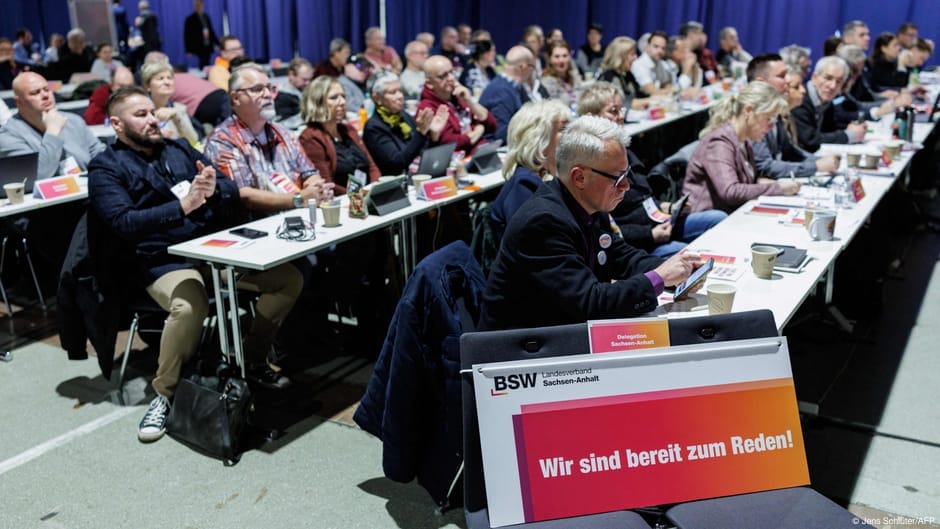
Delegates of the Alliance for Social Justice and Economic Reason (BSW) voted at their party conference in Dresden to reject a proposal that would have mandated a strict separation from the far-right Alternative for Germany (AfD). The motion, supported by several founding members, sought to explicitly rule out formal coalitions, tolerance of minority governments, and long-term cooperation agreements with the AfD, which is currently under surveillance by Germany's domestic intelligence agency.
Party founder Sahra Wagenknecht and leader Fabio De Masi advocated for the so-called "Magdeburg Model." This strategy avoids formal coalition agreements but allows for flexible, case-by-case cooperation on specific legislative motions or voting blocks. Wagenknecht argued that the party must remain pragmatic, stating that if opportunities arise to push for specific reforms regarding peace or social policy, the BSW should utilize them regardless of the source of the parliamentary majority.
The decision has caused significant friction within the BSW, which combines left-wing economic policies with a restrictive stance on migration. High-ranking members such as Christian Leye and Klaus Ernst voiced strong opposition, labeling the AfD a nationalist and racist organization that cannot be treated as a political partner. Ernst has even suggested he might depart from the party if a clear boundary is not established.
The stakes
The vote signals a potential shift in the German parliamentary landscape, particularly in eastern states where the BSW and AfD could together command a majority. If the BSW pursues this flexible cooperation, it risks alienating its base and internal dissenters while potentially normalizing the influence of the far-right in state-level governance.
Two readings
- Supporters argue that pragmatic, issue-based cooperation is necessary to achieve concrete policy changes and effectively challenge the status quo.
- Critics contend that any form of collaboration with the AfD legitimizes an extremist party, undermining the BSW's own democratic values and political integrity.
Source DW English — dw.com/en/germany-news-job-market-unlikely-to-recover-before-summer… ↗
Read next
 ✒️Opinion & Analysis
ICJ Rules Myanmar Military Committed Genocide Against Rohingya
The International Court of Justice has found Myanmar's military guilty of genocide against the Rohingya, a ruling that damages the international standing of both Aung San…
 🕯️Democracy & Rights
Chinese teachers face rising parental pressure over personal life choices
Chinese educators are encountering a surge in unreasonable demands from parents, including complaints regarding teachers' pregnancy and maternity leave.
 🛡️War & Security
Ukraine Restricts Media Coverage of Infrastructure Damage Amid Russian Strikes
President Volodymyr Zelenskyy has issued a decree prohibiting media outlets from reporting on the impact of Russian strikes against critical infrastructure and the status…
 🏮China & Taiwan
Beijing Reaffirms Reunification Stance Following Taiwan Local Election Results
China’s Taiwan Affairs Office declared that the island’s reunification with the mainland remains inevitable, despite recent shifts in Taiwan's local political landscape.
 ⚖️Law & Policy
India Government Proposes 50% Increase in Parliamentary Seats and Women's Reservation
The Indian government plans to introduce legislation to expand the Lok Sabha to 850 seats and mandate a 33% reservation for women in legislative bodies.
 ⚖️Law & Policy
India’s ruling alliance nears two-thirds majority for sweeping parliamentary expansion and delimitation bills
The National Democratic Alliance is nearing a two-thirds majority in Parliament to pass landmark legislation expanding the Lok Sabha by 50 percent and implementing a 33 p…