Trump’s participation signals a strategic shift for the Quad alliance
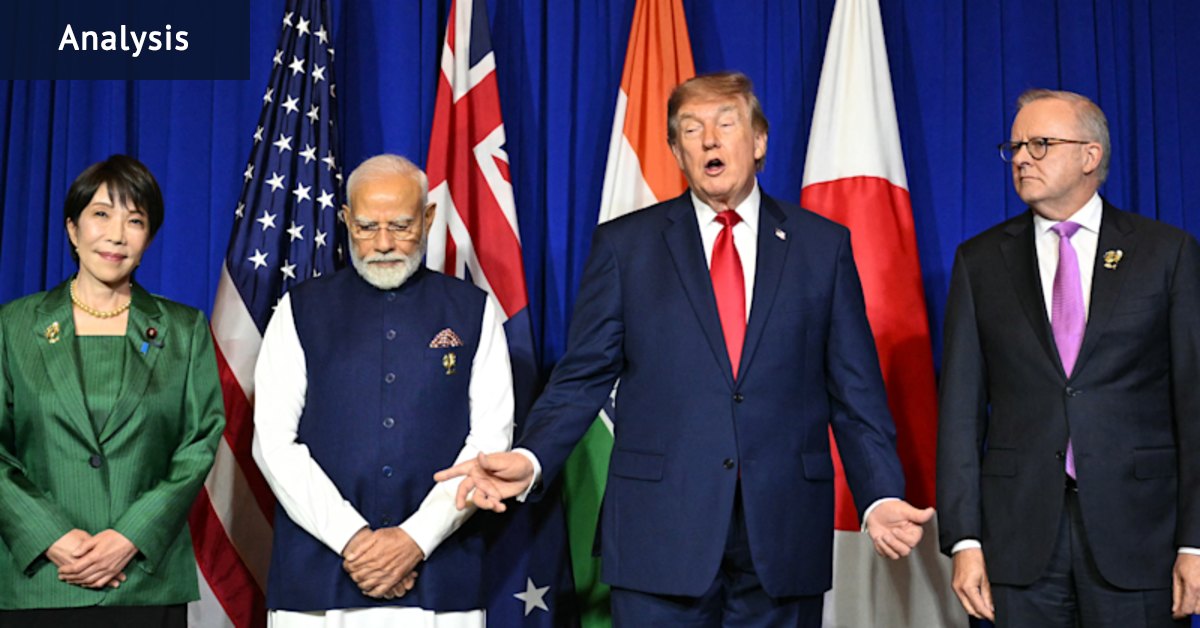
President Donald Trump attended his first Quad leaders' summit in Manila, marking a pivot toward harder-edged security cooperation among the four-nation bloc.
 ✒️Opinion & Analysis
Photo: SMH Politics
Key points
- The Quad confirmed its first explicit joint military patrol exercises for next year.
- The alliance is shifting focus from public goods to harder-edged security and supply chain independence.
- Trump’s participation in the Manila summit marks a departure from his previous disinterest in the grouping.
President Donald Trump’s participation in the recent Quad leaders’ summit in Manila signals a renewed commitment to the partnership between the United States, India, Japan, and Australia. Despite Trump’s previously limited personal engagement with the group, the summit produced a significant operational shift: the confirmation that the four nations will conduct joint maritime patrol aircraft exercises next year. This move marks the first time the coalition has formally badged military activities under the Quad banner, moving beyond the public-goods focus of previous years.
Analysts note that the grouping had faced criticism for drifting toward aimless working groups, but the current focus on deterrence suggests a more strategic trajectory. By formalizing military cooperation, the Quad is signaling a clearer stance on regional security in the Indo-Pacific. This development comes even as Trump continues to pursue high-level diplomatic engagement with leaders like Xi Jinping, highlighting a complex dynamic where his administration balances personal outreach to autocrats with institutional security commitments.
The shift toward explicit military exercises is expected to heighten tensions with Beijing, which has long viewed the Quad as a Cold War-style containment mechanism. As the group pivots toward critical mineral supply chain security and enhanced maritime surveillance, the potential for economic and military friction with China appears to be increasing.
The stakes
The transition to formal military exercises represents a significant escalation in regional deterrence, potentially curbing Chinese naval expansion in the Indo-Pacific. While this strengthens the strategic alignment of the four nations, it risks further isolating Beijing and complicates Trump’s broader, often contradictory, diplomatic strategy toward global strongmen.
Two readings
- Supporters view the shift as a necessary maturation of the Quad, transforming it from a loose diplomatic forum into a credible security mechanism capable of countering regional aggression.
- Critics argue that the move needlessly provokes China and risks destabilizing the region, while questioning the long-term consistency of a security commitment led by a president who has historically downplayed the group's importance.
Source SMH Politics — smh.com.au/politics/federal/thanks-to-trump-china-has-even-more-rea… ↗
Read next
 🕯️Democracy & Rights
Chinese teachers face rising parental pressure over personal life choices
Chinese educators are encountering a surge in unreasonable demands from parents, including complaints regarding teachers' pregnancy and maternity leave.
 🛡️War & Security
Ukraine Restricts Media Coverage of Infrastructure Damage Amid Russian Strikes
President Volodymyr Zelenskyy has issued a decree prohibiting media outlets from reporting on the impact of Russian strikes against critical infrastructure and the status…
 🏮China & Taiwan
Beijing Reaffirms Reunification Stance Following Taiwan Local Election Results
China’s Taiwan Affairs Office declared that the island’s reunification with the mainland remains inevitable, despite recent shifts in Taiwan's local political landscape.
 🇪🇺Europe
US Air Force Repels Unauthorized Drone Incursion at RAF Lakenheath
U.S. security forces at a British air base successfully countered a group of unidentified drones, amid growing concerns over potential foreign state involvement.
 ⚖️Law & Policy
India Government Proposes 50% Increase in Parliamentary Seats and Women's Reservation
The Indian government plans to introduce legislation to expand the Lok Sabha to 850 seats and mandate a 33% reservation for women in legislative bodies.
 ⚖️Law & Policy
India’s ruling alliance nears two-thirds majority for sweeping parliamentary expansion and delimitation bills
The National Democratic Alliance is nearing a two-thirds majority in Parliament to pass landmark legislation expanding the Lok Sabha by 50 percent and implementing a 33 p…