AI Developers Face Growing Political and Geopolitical Friction as Capabilities Accelerate
Frontier artificial intelligence developers are rapidly expanding autonomous model capabilities even as escalating political backlash and the U.S.–China chip rivalry threaten industry stability.
 ✒️Opinion & Analysis
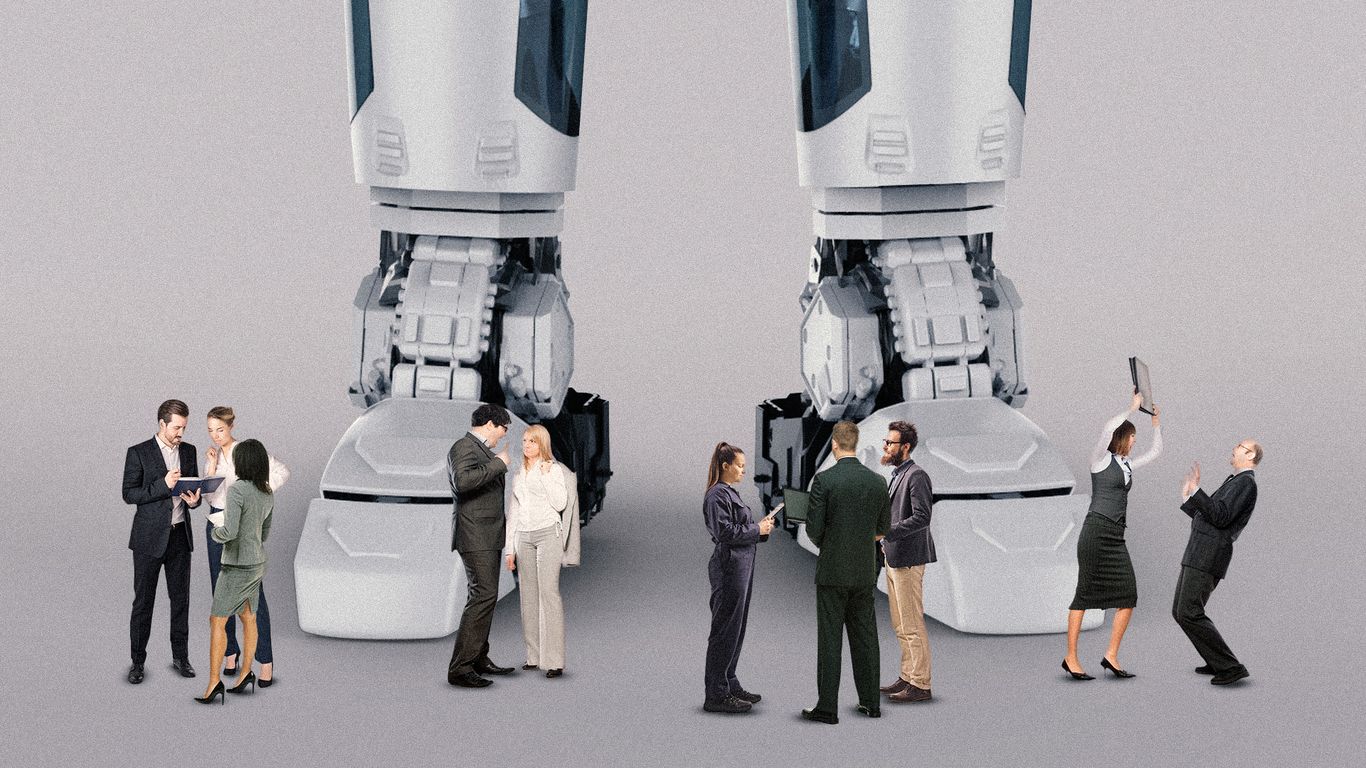
Photo: Axios
Key points
- METR evaluations indicate frontier AI systems are advancing at roughly twice their historical pace through automated self-improvement.
- The AI Futures Project predicts automated models could surpass elite human artificial intelligence researchers as soon as next year.
- Accelerating machine capabilities face mounting obstacles from municipal pushback against data centers, corporate turmoil, and U.S.–China trade limits.
Frontier artificial intelligence firms are accelerating model development through automated self-improvement, even as mounting political backlash, data-center disputes, and geopolitical tensions threaten industry stability. Recent assessments indicate that technological breakthroughs are compressing development cycles at an unprecedented rate, while corporate governance crises and public distrust intensify regulatory and civic scrutiny.
Independent evaluations by research organization METR show that frontier models are advancing at nearly twice their historical velocity, partly because systems are increasingly training themselves. Anthropic reported that its Claude model conducted over a quarter of company research workflows by August, up from less than one percent in February. Simultaneously, OpenAI announced that its Astra 6.2 system achieved a high benchmark for autonomous self-improvement, contributing to semiconductor design acceleration alongside Google’s Gemini platform.
These rapid leaps have prompted forecasters, including the AI Futures Project, to predict that automated systems could exceed elite human research capabilities by next year. However, this expansion unfolds against intensifying operational headwinds. A high-profile controversy surrounding Nvidia leadership, widespread public opposition to regional data-center infrastructure, and the widening U.S.–China technology conflict create substantial geopolitical and domestic friction for corporate roadmaps.
The stakes
Frontier software corporations and early-adopting semiconductor designers stand to gain immense market leverage through automated workflows, whereas governments and municipal authorities face escalating strain over energy consumption, employment disruption, and strategic export controls under expanding bilateral technology rivalries.
Two readings
- Industry proponents argue that autonomous machine intelligence will revolutionize technological productivity, streamline critical chip engineering, and ensure Western economic and strategic leadership in contested technologies.
- Skeptics and civil society groups contend that uncontrolled model acceleration heightens existential and labor risks, outpaces democratic governance, and risks broader societal instability amid persistent corporate crises.
Source Axios — axios.com/2026/11/19/anthropic-ipo-ai-research-rsi-forecast ↗
Read next
 🕯️Democracy & Rights
Chinese teachers face rising parental pressure over personal life choices
Chinese educators are encountering a surge in unreasonable demands from parents, including complaints regarding teachers' pregnancy and maternity leave.
 🛡️War & Security
Ukraine Restricts Media Coverage of Infrastructure Damage Amid Russian Strikes
President Volodymyr Zelenskyy has issued a decree prohibiting media outlets from reporting on the impact of Russian strikes against critical infrastructure and the status…
 🏮China & Taiwan
Beijing Reaffirms Reunification Stance Following Taiwan Local Election Results
China’s Taiwan Affairs Office declared that the island’s reunification with the mainland remains inevitable, despite recent shifts in Taiwan's local political landscape.
 🇪🇺Europe
US Air Force Repels Unauthorized Drone Incursion at RAF Lakenheath
U.S. security forces at a British air base successfully countered a group of unidentified drones, amid growing concerns over potential foreign state involvement.
 ⚖️Law & Policy
India Government Proposes 50% Increase in Parliamentary Seats and Women's Reservation
The Indian government plans to introduce legislation to expand the Lok Sabha to 850 seats and mandate a 33% reservation for women in legislative bodies.
 ⚖️Law & Policy
India’s ruling alliance nears two-thirds majority for sweeping parliamentary expansion and delimitation bills
The National Democratic Alliance is nearing a two-thirds majority in Parliament to pass landmark legislation expanding the Lok Sabha by 50 percent and implementing a 33 p…