Uzbekistan Proposes Regional Climate Integration Model at COP31
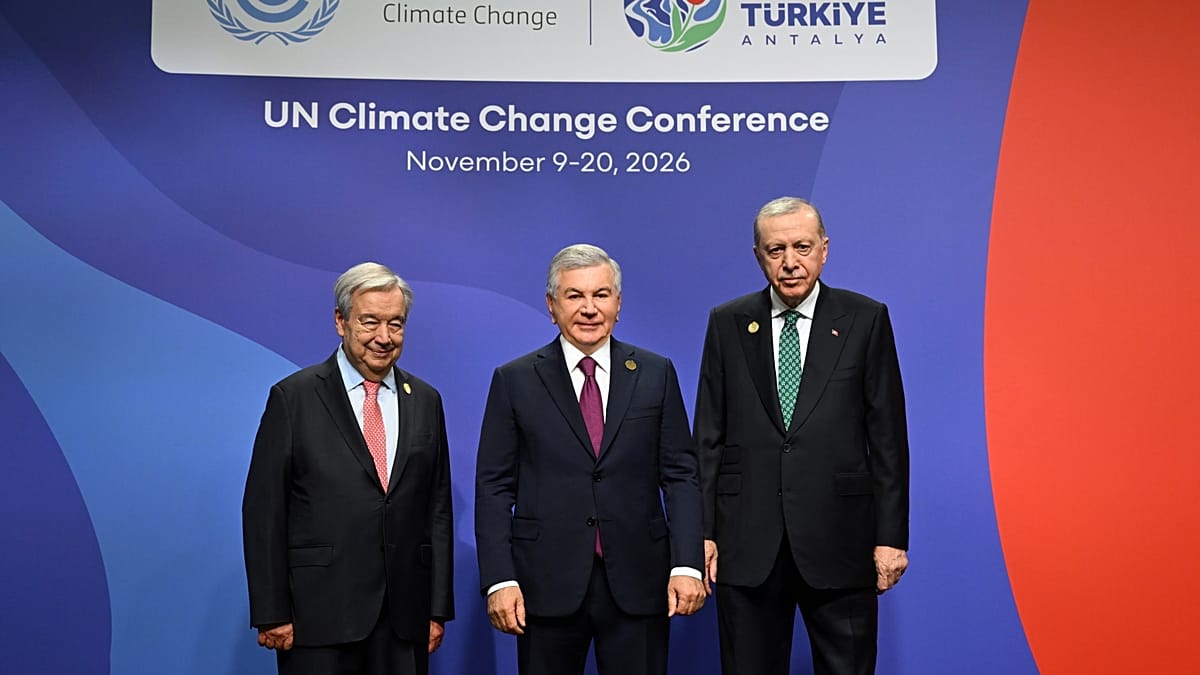
Uzbekistan’s President Shavkat Mirziyoyev has unveiled a regional climate cooperation framework at COP31, emphasizing shared water security and disaster monitoring. The initiative coincides with the launch of a major multi-million euro climate resilience program for Central Asia.
 ⚖️Law & Policy
Photo: Euronews
Key points
- President Mirziyoyev proposed a regional climate integration model focusing on data sharing and disaster warnings.
- A €264.4 million climate resilience program was launched for Uzbekistan, Kyrgyzstan, and Tajikistan.
- Uzbekistan aims to achieve 54% renewable energy in its electricity mix by 2030.
At the COP31 UN climate conference in Antalya, Uzbekistan President Shavkat Mirziyoyev introduced a three-part "Climate Integration Model" designed to foster regional cooperation across Central Asia. The proposal aims to address critical environmental threats, including the rapid depletion of glaciers, persistent water scarcity, and the increasing frequency of droughts that jeopardize agriculture and energy stability in the region.
The framework centers on three primary pillars: the establishment of a regional early warning system for natural disasters, the promotion of green technologies to combat desertification and sandstorms, and the creation of new financing mechanisms to support climate adaptation. Mirziyoyev emphasized that the regional nature of these environmental challenges necessitates a collective response, noting that Uzbekistan will assume leadership of the International Fund for Saving the Aral Sea in 2027 to further these goals.
Complementing the proposal, a new seven-year initiative titled Climate-Resilient Landscapes in Central Asia (CLiCA) was officially launched. Backed by the Green Climate Fund and German development partners, the program provides €264.4 million to assist Uzbekistan, Kyrgyzstan, and Tajikistan. Uzbekistan is slated to receive €103.7 million of these funds, which will be directed toward restoring forest and pasture lands, implementing advanced irrigation techniques, and providing climate advisory services to thousands of local farmers.
The stakes
The success of this initiative will determine the long-term stability of Central Asia's water-dependent economies. If implemented effectively, regional governments stand to gain improved resource management and increased protection for rural populations, while failure to coordinate could exacerbate cross-border tensions over diminishing water supplies and accelerate environmental degradation.
Two readings
- Supporters view the model as a necessary shift toward regional solidarity, arguing that shared data and unified funding are the only ways to mitigate the existential threat posed by climate change in arid environments.
- Critics or skeptics may point to the historical difficulty of aligning the diverse political and economic interests of Central Asian states, questioning whether these frameworks can overcome long-standing geopolitical friction to deliver tangible results.
Source Euronews — euronews.com/2026/11/12/uzbekistan-calls-for-shared-early-warnings-… ↗
Read next
 ✒️Opinion & Analysis
ICJ Rules Myanmar Military Committed Genocide Against Rohingya
The International Court of Justice has found Myanmar's military guilty of genocide against the Rohingya, a ruling that damages the international standing of both Aung San…
 🕯️Democracy & Rights
Chinese teachers face rising parental pressure over personal life choices
Chinese educators are encountering a surge in unreasonable demands from parents, including complaints regarding teachers' pregnancy and maternity leave.
 🛡️War & Security
Ukraine Restricts Media Coverage of Infrastructure Damage Amid Russian Strikes
President Volodymyr Zelenskyy has issued a decree prohibiting media outlets from reporting on the impact of Russian strikes against critical infrastructure and the status…
 🏮China & Taiwan
Beijing Reaffirms Reunification Stance Following Taiwan Local Election Results
China’s Taiwan Affairs Office declared that the island’s reunification with the mainland remains inevitable, despite recent shifts in Taiwan's local political landscape.
 🇪🇺Europe
US Air Force Repels Unauthorized Drone Incursion at RAF Lakenheath
U.S. security forces at a British air base successfully countered a group of unidentified drones, amid growing concerns over potential foreign state involvement.
 🕯️Democracy & Rights
Malaysia to Display Artworks Recovered in 1MDB Corruption Scandal
The Malaysian National Art Gallery will exhibit four pieces of art previously linked to the 1MDB financial scandal, following their successful repatriation to the country…