Pakistan’s Federal Constitutional Court Marks One Year Amid Judicial Controversy
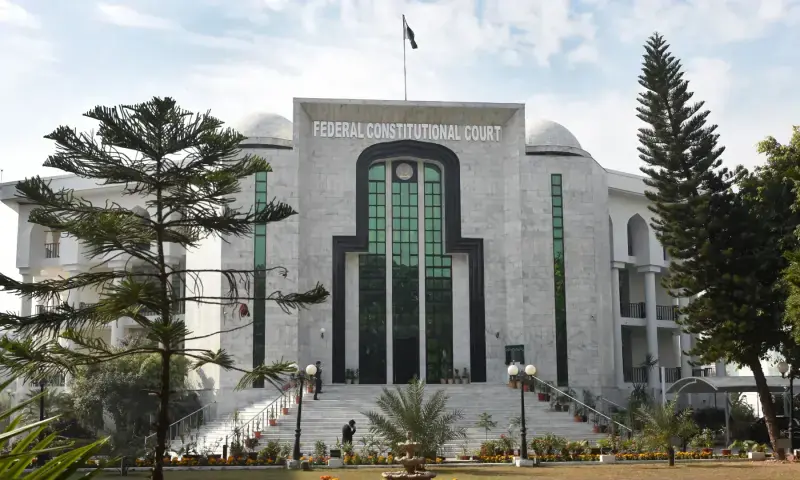
The Federal Constitutional Court of Pakistan has completed its first year of operation, a period defined by significant jurisdictional shifts and persistent criticism regarding its independence.
 ⚖️Law & Policy
Photo: Dawn
Key points
- The FCC marked its first anniversary after receiving 22,259 cases from the Supreme Court.
- A landmark ruling established that FCC decisions are binding on all other Pakistani courts, including the Supreme Court.
- Legal groups and the opposition continue to challenge the court's legitimacy, citing executive influence over judicial appointments.
The Federal Constitutional Court (FCC) of Pakistan marked its one-year anniversary on Friday, celebrating the transition of its judicial role since its inception on November 13, 2025. Established under the 27th Constitutional Amendment, the court was designed to handle constitutional and appellate matters, leading to the transfer of over 22,000 cases from the Supreme Court to its docket. During the anniversary ceremony, Chief Justice Aminuddin Khan reflected on the swift passage of time since the court began formal operations in November 2025.
The creation of the FCC has fundamentally altered the nation's judicial hierarchy. A key ruling clarified that the FCC’s decisions are binding on all other courts, including the Supreme Court itself, asserting a new legal supremacy. Despite these structural changes, the court currently operates with only seven of its 13 sanctioned judicial positions filled, and there have been no new appointments since its launch.
The institution remains a point of contention between the government and legal professionals. Critics, including the Democratic Alliance and various opposition leaders, have labeled the court a tool of the executive branch, arguing that its formation undermines judicial independence. The absence of Supreme Court leadership at the FCC’s inaugural ceremonies highlighted the ongoing friction between the two judicial bodies, while recent orders restricting high court interventions in political matters have further intensified public debate.
The stakes
The continued operation of the FCC shifts the balance of power away from the traditional Supreme Court, centralizing constitutional interpretation under a body whose appointments are heavily influenced by the executive. If the court maintains its current trajectory, the executive branch gains a more compliant judicial partner, while the traditional judiciary loses its role as the ultimate arbiter of constitutional law, potentially weakening checks and balances in the Pakistani state.
Two readings
- Supporters view the FCC as a necessary reform to streamline the judicial process and reduce the massive backlog of cases that has long plagued the Supreme Court.
- Critics argue the court is an unconstitutional instrument of political control, created by an unrepresentative legislature to bypass judicial independence and protect executive interests.
Source Dawn — dawn.com/news/2044385/situationer-time-flies-after-judicial-hierarc… ↗
Read next
 ✒️Opinion & Analysis
ICJ Rules Myanmar Military Committed Genocide Against Rohingya
The International Court of Justice has found Myanmar's military guilty of genocide against the Rohingya, a ruling that damages the international standing of both Aung San…
 🕯️Democracy & Rights
Chinese teachers face rising parental pressure over personal life choices
Chinese educators are encountering a surge in unreasonable demands from parents, including complaints regarding teachers' pregnancy and maternity leave.
 🛡️War & Security
Ukraine Restricts Media Coverage of Infrastructure Damage Amid Russian Strikes
President Volodymyr Zelenskyy has issued a decree prohibiting media outlets from reporting on the impact of Russian strikes against critical infrastructure and the status…
 🏮China & Taiwan
Beijing Reaffirms Reunification Stance Following Taiwan Local Election Results
China’s Taiwan Affairs Office declared that the island’s reunification with the mainland remains inevitable, despite recent shifts in Taiwan's local political landscape.
 🇪🇺Europe
US Air Force Repels Unauthorized Drone Incursion at RAF Lakenheath
U.S. security forces at a British air base successfully countered a group of unidentified drones, amid growing concerns over potential foreign state involvement.
 🕯️Democracy & Rights
Malaysia to Display Artworks Recovered in 1MDB Corruption Scandal
The Malaysian National Art Gallery will exhibit four pieces of art previously linked to the 1MDB financial scandal, following their successful repatriation to the country…