Crimean Court Imprisons Four Jehovah's Witnesses on Extremism Charges
A court in Russian-annexed Crimea has sentenced four members of the Jehovah's Witnesses to prison terms of up to eight years for extremist activity.
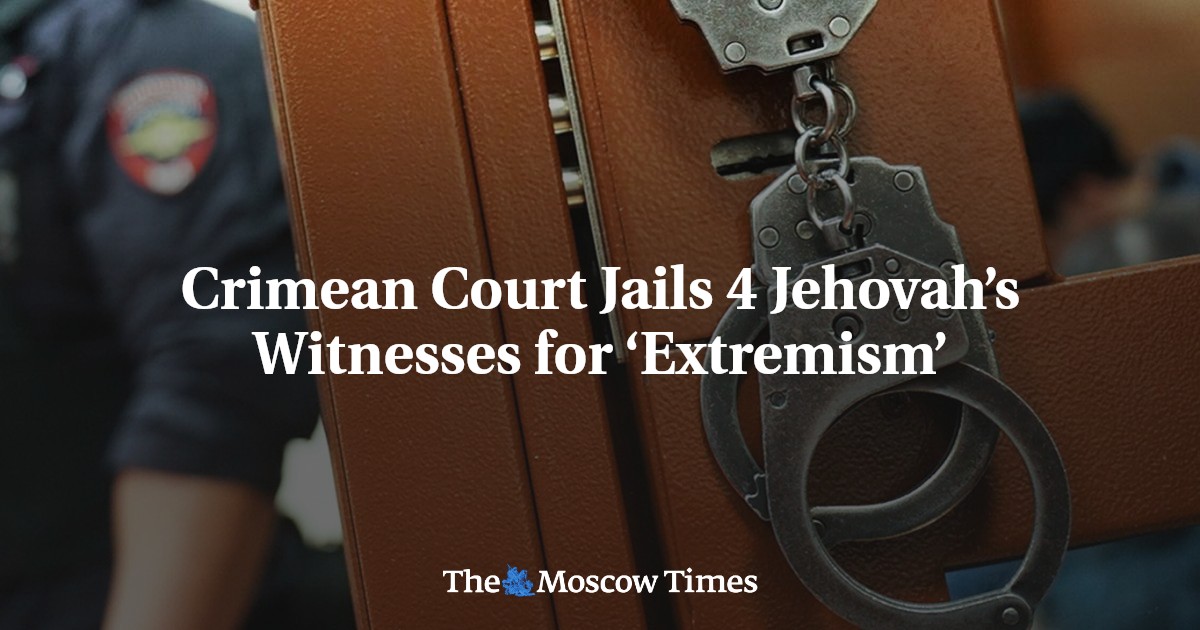 🕊️Russia & Ukraine
Photo: Moscow Times
Key points
- Four Jehovah's Witnesses convicted of extremism in Crimea
- Sentences reach up to eight years in prison
- Defense cites reliance on secret witnesses and wiretaps
A judicial authority in annexed Crimea has convicted four adherents of the Jehovah's Witnesses of participating in extremist activities, delivering prison sentences ranging from three to eight years. According to organization spokesperson Jarrod Lopes, defendants Alexander Kopylets, Alexander Voronchikhin, and Dmitriy Zakharevich received custodial terms of eight, seven and a half, and six and a half years respectively, while Yekaterina Demidova was given a three-year suspended sentence.
Representatives for the Christian denomination stated that the prosecution relied heavily on wiretapped private conversations and testimony from anonymous witnesses. During court proceedings, the accused individuals maintained their innocence, arguing they were merely exercising their right to practice their religious beliefs peacefully. This ruling adds to an ongoing crackdown following Moscow's 2017 nationwide ban on the faith group, which the Kremlin classified as an extremist organization.
International bodies have repeatedly criticized the prohibition. The European Court of Human Rights determined in 2022 that the ban infringed upon fundamental rights to freedom of religion and expression, a finding echoed by the United Nations Human Rights Committee. Despite these condemnations, authorities continue to prosecute members across Russian-controlled territories, bringing the total number of imprisoned adherents to 185.
The stakes
This verdict heightens the legal risks for religious minorities operating under Russian jurisdiction, particularly in occupied territories. If current judicial trends persist, adherents face prolonged imprisonment for private worship, while the broader civil society experiences further erosion of religious freedoms.
Two readings
- Supporters of the judicial action argue that the state is legitimately enforcing national security legislation against groups designated as extremist.
- Critics contend that the prosecutions represent a severe violation of human rights and international law, weaponizing anti-extremism statutes to suppress peaceful religious practice.
Source Moscow Times — themoscowtimes.com/2026/11/27/crimean-court-jails-4-jehovah-s-witne… ↗
Read next
 ✒️Opinion & Analysis
ICJ Rules Myanmar Military Committed Genocide Against Rohingya
The International Court of Justice has found Myanmar's military guilty of genocide against the Rohingya, a ruling that damages the international standing of both Aung San…
 🕯️Democracy & Rights
Chinese teachers face rising parental pressure over personal life choices
Chinese educators are encountering a surge in unreasonable demands from parents, including complaints regarding teachers' pregnancy and maternity leave.
 🛡️War & Security
Ukraine Restricts Media Coverage of Infrastructure Damage Amid Russian Strikes
President Volodymyr Zelenskyy has issued a decree prohibiting media outlets from reporting on the impact of Russian strikes against critical infrastructure and the status…
 🏮China & Taiwan
Beijing Reaffirms Reunification Stance Following Taiwan Local Election Results
China’s Taiwan Affairs Office declared that the island’s reunification with the mainland remains inevitable, despite recent shifts in Taiwan's local political landscape.
 🇪🇺Europe
US Air Force Repels Unauthorized Drone Incursion at RAF Lakenheath
U.S. security forces at a British air base successfully countered a group of unidentified drones, amid growing concerns over potential foreign state involvement.
 ⚖️Law & Policy
India Government Proposes 50% Increase in Parliamentary Seats and Women's Reservation
The Indian government plans to introduce legislation to expand the Lok Sabha to 850 seats and mandate a 33% reservation for women in legislative bodies.