Gaza Humanitarian Crisis Deepens Amid Post-War Political Deadlock
Severe winter weather in Gaza has worsened living conditions for displaced residents as political friction stalls postwar governance, reconstruction, and relief efforts.
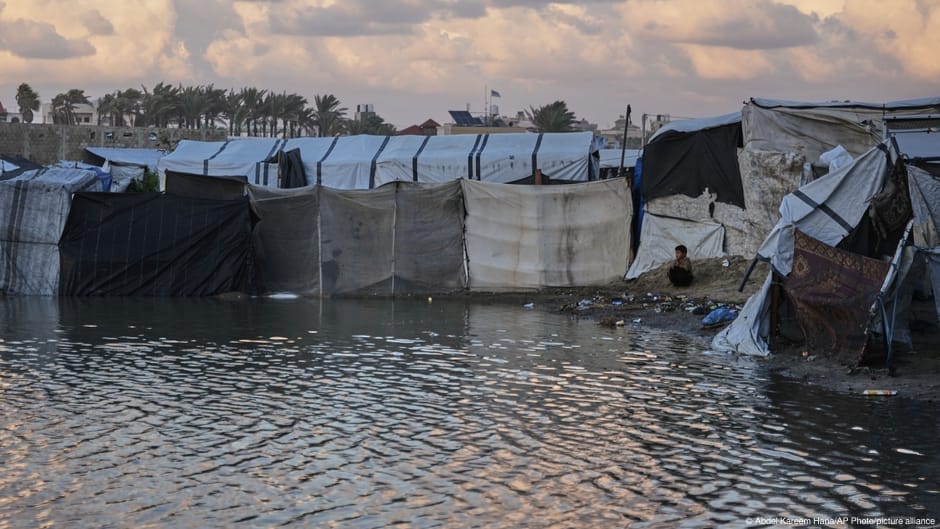 🛡️War & Security
Photo: DW English
Key points
- Heavy rainfall flooded over 70,000 tents across Gaza, causing multiple deaths.
- The Board of Peace criticized Israeli humanitarian measures as insufficient for winter needs.
- Reconstruction efforts remain deadlocked over demands for Hamas disarmament and troop withdrawals.
Torrential rainfall and dropping temperatures over the weekend intensified the humanitarian crisis in Gaza, flooding tens of thousands of tents and leaving hundreds of thousands of displaced civilians struggling against mud and cold. According to UNICEF, at least six people, including children, died as a result of the extreme weather. Relief operations have faced severe constraints due to restricted land access, with the UN Office for the Coordination of Humanitarian Affairs noting that Israeli restrictions behind the military demarcation known as the Yellow Line keep most of the territory off-limits for relocation and shelter expansion.
The severe weather coincides with a persistent political stalemate regarding postwar governance and reconstruction. Under a US-brokered arrangement, the Board of Peace was established to oversee the transition, but negotiations have stalled over conflicting demands regarding the disarmament of Hamas and the withdrawal of Israeli military forces. Although international assessments estimate that Gaza's reconstruction will require billions of dollars over the coming decade, ongoing hostilities, airstrikes, and administrative restrictions continue to hamper basic recovery efforts.
Amid mounting pressure, the Board of Peace recently issued a public statement declaring that Israeli measures to improve seasonal humanitarian conditions remain inadequate, urging authorities to authorize the immediate entry of winter supplies. Nathan Brown, a professor of political science at George Washington University, noted that the severe weather highlights the fundamental paralysis of the international peace framework, driven by competing security demands and political friction.
The stakes
Displaced civilians bear the immediate cost of the ongoing political stalemate through unsafe living conditions and delayed winter aid. If international bodies and regional governments fail to bridge the gap between security demands and humanitarian needs, tens of thousands of families will remain exposed to extreme weather and health hazards indefinitely.
Two readings
- Supporters of the international oversight framework argue that public pressure from bodies like the Board of Peace is essential to compel authorities to ease restrictions and allow critical winter supplies into the territory.
- Critics contend that international mediation efforts remain structurally flawed because they fail to resolve the core military and governance disputes dividing the parties on the ground.
Source DW English — dw.com/en/humanitarian-situation-in-gaza-worsens-amid-political-dea… ↗
Read next
 ✒️Opinion & Analysis
ICJ Rules Myanmar Military Committed Genocide Against Rohingya
The International Court of Justice has found Myanmar's military guilty of genocide against the Rohingya, a ruling that damages the international standing of both Aung San…
 🕯️Democracy & Rights
Chinese teachers face rising parental pressure over personal life choices
Chinese educators are encountering a surge in unreasonable demands from parents, including complaints regarding teachers' pregnancy and maternity leave.
 🏮China & Taiwan
Beijing Reaffirms Reunification Stance Following Taiwan Local Election Results
China’s Taiwan Affairs Office declared that the island’s reunification with the mainland remains inevitable, despite recent shifts in Taiwan's local political landscape.
 🇪🇺Europe
US Air Force Repels Unauthorized Drone Incursion at RAF Lakenheath
U.S. security forces at a British air base successfully countered a group of unidentified drones, amid growing concerns over potential foreign state involvement.
 ⚖️Law & Policy
India Government Proposes 50% Increase in Parliamentary Seats and Women's Reservation
The Indian government plans to introduce legislation to expand the Lok Sabha to 850 seats and mandate a 33% reservation for women in legislative bodies.
 ⚖️Law & Policy
India’s ruling alliance nears two-thirds majority for sweeping parliamentary expansion and delimitation bills
The National Democratic Alliance is nearing a two-thirds majority in Parliament to pass landmark legislation expanding the Lok Sabha by 50 percent and implementing a 33 p…