Escalating Foreign Intervention in Haiti Raises Security and Political Concerns
The disappearance of four Salvadoran airmen in Haiti highlights the risks of an increasingly militarized international response to the nation's gang crisis.
 🛡️War & Security
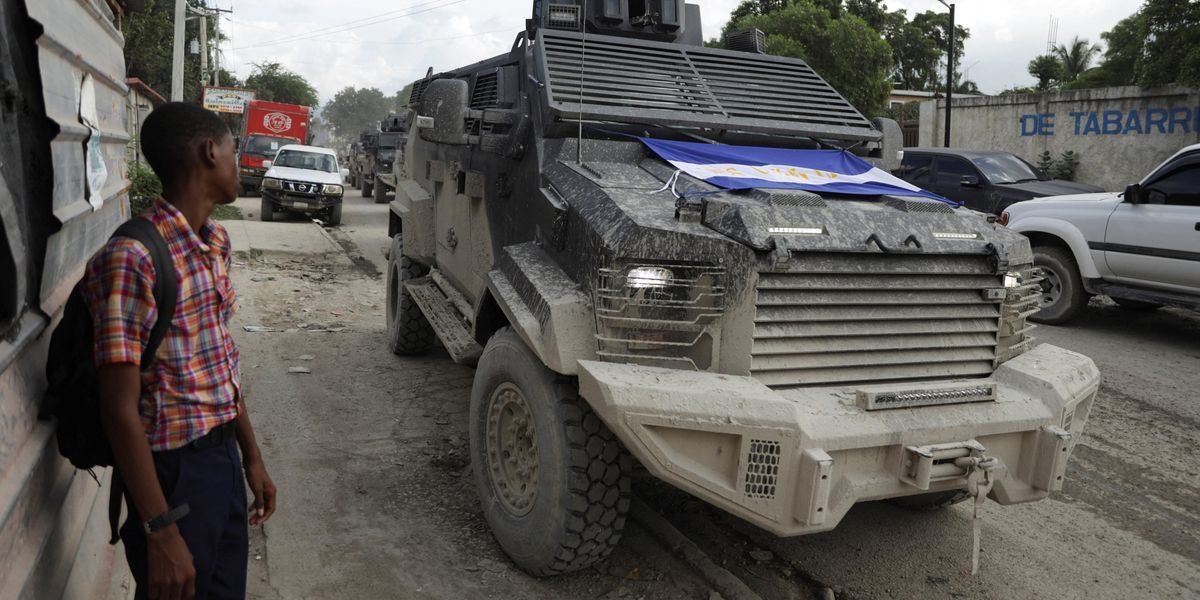
Photo: Responsible Statecraft
Key points
- Four Salvadoran airmen went missing in a gang-controlled area near Port-au-Prince.
- The U.N.-authorized Gang Suppression Force has been granted an aggressive, independent mandate.
- Critics argue that military-focused interventions fail to address the systemic flow of illegal firearms and political instability.
The security situation in Haiti has intensified following the disappearance of four Salvadoran airmen in a gang-controlled suburb of Port-au-Prince. The personnel were part of a growing international presence aimed at curbing the influence of armed coalitions, such as Viv Ansanm, which currently control significant portions of the capital. While El Salvador’s President Nayib Bukele initially characterized his country's deployment as a medical evacuation mission, the contingent has since expanded to approximately 2,500 troops, supported by U.S. logistics.
The international response has shifted toward a more aggressive posture with the establishment of the Gang Suppression Force (GSF). Authorized by the U.N. Security Council through March 2027, the GSF maintains a mandate to conduct offensive operations independent of local police. Parallel to this, the Haitian government has contracted private security firm Vectus Global, led by Erik Prince, to deploy drone surveillance and strike capabilities. These efforts follow the U.S. designation of major Haitian gangs as foreign terrorist organizations, a move that critics argue complicates potential political solutions.
Despite these interventions, observers note that the root causes of the violence—including the influx of illicit firearms from the United States and deep-seated political instability—remain largely unaddressed. Analysts warn that relying on military-centric strategies, such as drone strikes and heavy troop deployments, may inadvertently strengthen gang recruitment by fueling anti-foreign sentiment and increasing civilian casualties.
The stakes
The current trajectory risks transforming Haiti into a permanent theater for multinational proxy conflicts. If the militarized approach fails to stabilize the country, the Haitian government faces further loss of legitimacy, while international backers risk deeper entanglement in a protracted, high-casualty security quagmire that could destabilize the broader Caribbean region.
Two readings
- Supporters argue that the severity of the gang crisis and the collapse of state authority necessitate robust, offensive military intervention to restore order and protect civilians.
- Critics contend that foreign-led, force-heavy strategies ignore the political origins of the gangs and that reliance on private contractors and external military power worsens the humanitarian crisis.
Source Responsible Statecraft — responsiblestatecraft.org/haiti-el-salvador-gangs/ ↗
Read next
 ✒️Opinion & Analysis
ICJ Rules Myanmar Military Committed Genocide Against Rohingya
The International Court of Justice has found Myanmar's military guilty of genocide against the Rohingya, a ruling that damages the international standing of both Aung San…
 🕯️Democracy & Rights
Chinese teachers face rising parental pressure over personal life choices
Chinese educators are encountering a surge in unreasonable demands from parents, including complaints regarding teachers' pregnancy and maternity leave.
 🏮China & Taiwan
Beijing Reaffirms Reunification Stance Following Taiwan Local Election Results
China’s Taiwan Affairs Office declared that the island’s reunification with the mainland remains inevitable, despite recent shifts in Taiwan's local political landscape.
 🇪🇺Europe
US Air Force Repels Unauthorized Drone Incursion at RAF Lakenheath
U.S. security forces at a British air base successfully countered a group of unidentified drones, amid growing concerns over potential foreign state involvement.
 ⚖️Law & Policy
India Government Proposes 50% Increase in Parliamentary Seats and Women's Reservation
The Indian government plans to introduce legislation to expand the Lok Sabha to 850 seats and mandate a 33% reservation for women in legislative bodies.
 ⚖️Law & Policy
India’s ruling alliance nears two-thirds majority for sweeping parliamentary expansion and delimitation bills
The National Democratic Alliance is nearing a two-thirds majority in Parliament to pass landmark legislation expanding the Lok Sabha by 50 percent and implementing a 33 p…