US Army Equips 11 Divisions with Unmanned Systems Under Drone Initiative
The US Army has supplied launched effects unmanned systems to 11 of its 12 headquarters divisions, driven largely by Griffon Aerospace deliveries and new acquisition authorities.
 🛡️War & Security
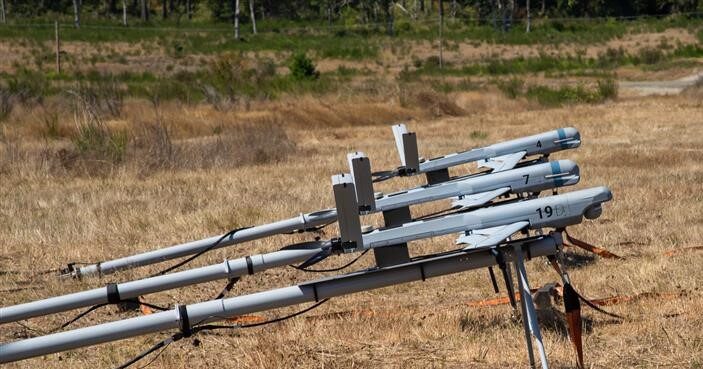
Photo: Breaking Defense
Key points
- 11 of 12 Army headquarters divisions equipped with launched effects
- Griffon Aerospace supplies majority of platforms via rapid contracting
- Effort tied to Defense Secretary Pete Hegseth's Drone Dominance memo
The United States Army has successfully distributed launched effects unmanned systems to 11 of its 12 headquarters divisions and every multi-domain task force, according to senior service officials. Lt. Col. Hunter Gray announced that the swift deployment aligns with the 2025 Drone Dominance directive issued by Defense Secretary Pete Hegseth, which mandates that all headquarters divisions and multi-domain task forces receive these aerial platforms ahead of a late 2026 deadline. The final division is scheduled to receive its equipment beginning next month.
Launched effects are aerial vehicles or payloads deployed from ground, maritime, or crewed aircraft platforms to execute both kinetic and non-kinetic missions. According to military officials, the capabilities range from intelligence, surveillance, and reconnaissance to electronic warfare. Dual-use manufacturer Griffon Aerospace has supplied the majority of these systems, providing hundreds of units monthly from its drone portfolio, which includes the Outlaw model. Officials highlighted that rapid acquisition authorities, such as Other Transaction Authorities, have enabled the service to scale procurement efficiently by cutting down standard contracting timelines.
Despite the swift distribution to division levels, military leadership acknowledged ongoing challenges regarding wider implementation. Earlier reports noted that while the inventory possesses enough small, one-way attack drones to equip every squad, the service still faces hurdles in training sufficient personnel to operate the systems at the tactical level.
The stakes
The rapid fielding of autonomous systems alters force projection capabilities, granting units extended operational reach while keeping personnel removed from direct threats. Industry partners secure lucrative, fast-tracked defense contracts, though the military must overcome training and workforce bottlenecks to ensure these technologies are effectively integrated into frontline squads.
Two readings
- Supporters read the story as a successful demonstration of defense acquisition reform, proving that commercial supply chains and rapid contracting tools can quickly deliver critical capabilities to warfighters.
- Critics read the story as a warning sign of persistent structural gaps, noting that surging hardware procurement ahead of training capacity risks accumulating uncrewed systems that tactical units cannot yet fully staff or operate.
Source Breaking Defense — breakingdefense.com/2026/11/army-fields-launched-effects-to-11-of-12-di… ↗
Read next
 ✒️Opinion & Analysis
ICJ Rules Myanmar Military Committed Genocide Against Rohingya
The International Court of Justice has found Myanmar's military guilty of genocide against the Rohingya, a ruling that damages the international standing of both Aung San…
 🕯️Democracy & Rights
Chinese teachers face rising parental pressure over personal life choices
Chinese educators are encountering a surge in unreasonable demands from parents, including complaints regarding teachers' pregnancy and maternity leave.
 🏮China & Taiwan
Beijing Reaffirms Reunification Stance Following Taiwan Local Election Results
China’s Taiwan Affairs Office declared that the island’s reunification with the mainland remains inevitable, despite recent shifts in Taiwan's local political landscape.
 🇪🇺Europe
US Air Force Repels Unauthorized Drone Incursion at RAF Lakenheath
U.S. security forces at a British air base successfully countered a group of unidentified drones, amid growing concerns over potential foreign state involvement.
 ⚖️Law & Policy
India Government Proposes 50% Increase in Parliamentary Seats and Women's Reservation
The Indian government plans to introduce legislation to expand the Lok Sabha to 850 seats and mandate a 33% reservation for women in legislative bodies.
 ⚖️Law & Policy
India’s ruling alliance nears two-thirds majority for sweeping parliamentary expansion and delimitation bills
The National Democratic Alliance is nearing a two-thirds majority in Parliament to pass landmark legislation expanding the Lok Sabha by 50 percent and implementing a 33 p…