Ukraine's Unmanned Systems Forces Forge a New Domain of War
Ukraine's military leadership created a dedicated branch for unmanned systems, challenging classical military doctrine and prioritizing rapid technological adaptation on the battlefield.
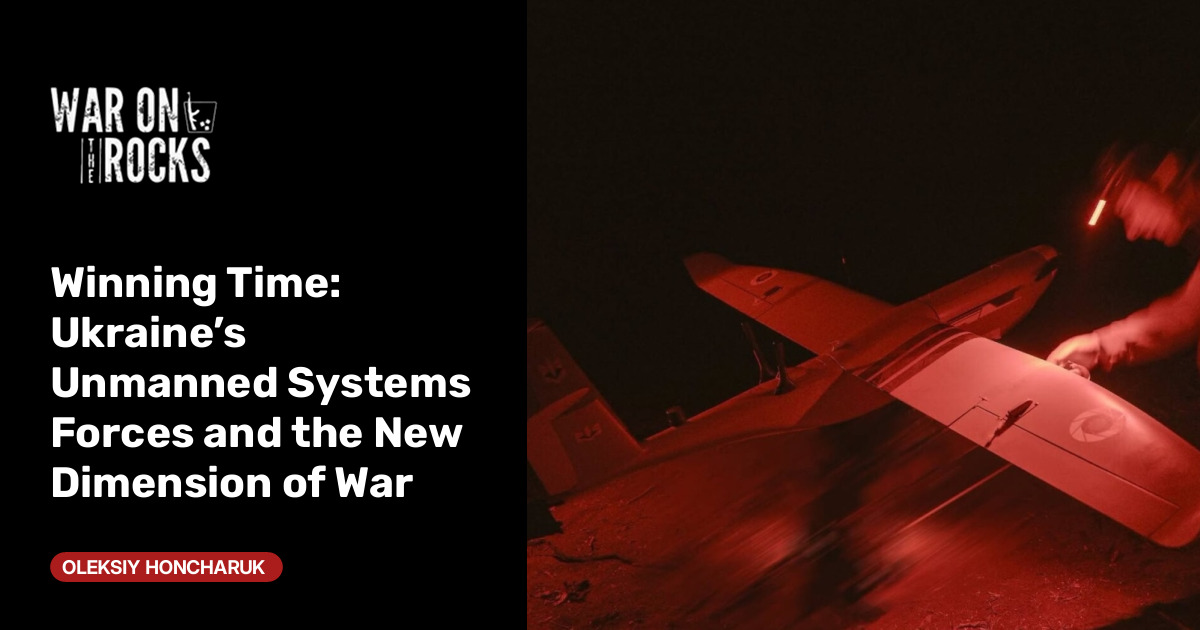 🛡️War & Security
Photo: War on the Rocks
Key points
- Ukraine established the world's first Unmanned Systems Forces in late 2023.
- The specialized branch accounts for a third of Russian losses with only 2.5 percent of personnel.
- The concept redefines military advantage around the speed of technological adaptation rather than fixed physical domains.
In late 2023, Ukraine established the Unmanned Systems Forces as a distinct branch of its military, breaking with classical doctrine that restricts service branches to physical domains like land, sea, and air. While career generals argued that drones operate across existing environments rather than possessing their own, civilian newcomers and reform-minded officers pressed for the institutional split. Today, this specialized branch accounts for approximately a third of Russian losses despite comprising only about 2.5 percent of Ukraine's military personnel.
The creation of the new force reflects a cultural shift toward continuous experimentation, rapid prototyping, and combat testing over pre-defined protocols. According to military analysts, the decisive element in the current conflict is not the physical territory contested, but the velocity of adaptation between opposing sides. In what is described as the Time Domain, military units compete to minimize the interval between introducing a new tactical capability and the enemy's deployment of an effective countermeasure.
Under conditions of severe asymmetry in personnel, armor, and artillery, Ukraine's innovation speed has functioned as a core requirement for survival. By continuously updating tactics and technology faster than Russian forces, Ukrainian drone units have managed to set the terms of engagement despite holding fewer resources overall.
The stakes
The institutionalization of the Unmanned Systems Forces establishes a permanent framework for modern technological warfare, determining whether armies worldwide will restructure their command hierarchies to prioritize rapid engineering cycles over traditional, static doctrine.
Two readings
- Supporters read the move as a visionary adaptation that institutionalizes speed and innovation, creating a necessary new operational category to win asymmetric conflicts.
- Critics read the separate branch as a departure from classical military doctrine that miscategorizes tactical speed as a distinct physical domain rather than an attribute of general warfare.
Source War on the Rocks — warontherocks.com/winning-time-ukraines-unmanned-systems-forces-and-the… ↗
Read next
 ✒️Opinion & Analysis
ICJ Rules Myanmar Military Committed Genocide Against Rohingya
The International Court of Justice has found Myanmar's military guilty of genocide against the Rohingya, a ruling that damages the international standing of both Aung San…
 🕯️Democracy & Rights
Chinese teachers face rising parental pressure over personal life choices
Chinese educators are encountering a surge in unreasonable demands from parents, including complaints regarding teachers' pregnancy and maternity leave.
 🏮China & Taiwan
Beijing Reaffirms Reunification Stance Following Taiwan Local Election Results
China’s Taiwan Affairs Office declared that the island’s reunification with the mainland remains inevitable, despite recent shifts in Taiwan's local political landscape.
 🇪🇺Europe
US Air Force Repels Unauthorized Drone Incursion at RAF Lakenheath
U.S. security forces at a British air base successfully countered a group of unidentified drones, amid growing concerns over potential foreign state involvement.
 ⚖️Law & Policy
India Government Proposes 50% Increase in Parliamentary Seats and Women's Reservation
The Indian government plans to introduce legislation to expand the Lok Sabha to 850 seats and mandate a 33% reservation for women in legislative bodies.
 ⚖️Law & Policy
India’s ruling alliance nears two-thirds majority for sweeping parliamentary expansion and delimitation bills
The National Democratic Alliance is nearing a two-thirds majority in Parliament to pass landmark legislation expanding the Lok Sabha by 50 percent and implementing a 33 p…