Erdogan Reaffirms Turkish Support for Azerbaijan’s South Caucasus Peace Initiatives
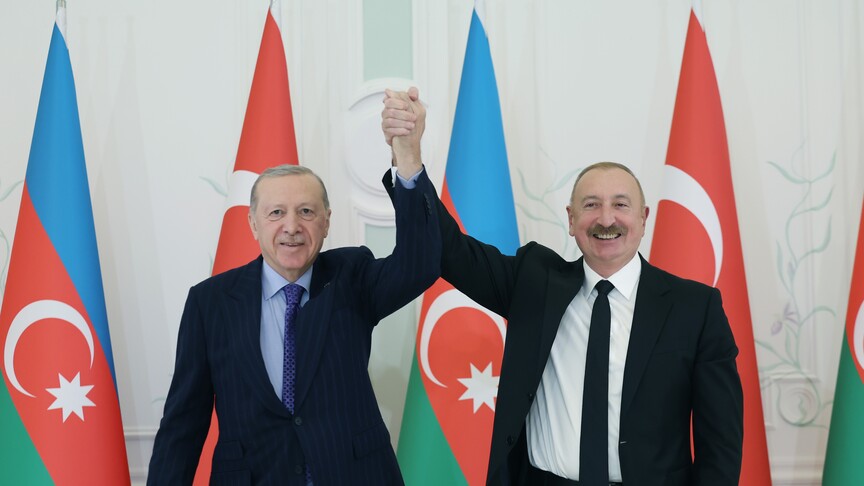
Turkish President Recep Tayyip Erdogan and Azerbaijani President Ilham Aliyev met in Shusha to celebrate the anniversary of the liberation of Karabakh and reinforce their strategic alliance.
 🤝Diplomacy
Photo: Anadolu
Key points
- President Erdogan reaffirmed support for Azerbaijan's peace efforts in the South Caucasus.
- The leaders met in Shusha to mark the anniversary of the 2020 Karabakh liberation.
- The 2021 Shusha Declaration was highlighted as the foundation of their current strategic alliance.
Turkish President Recep Tayyip Erdogan has publicly pledged his nation's continued backing for Azerbaijan’s pursuit of a permanent peace agreement in the South Caucasus. Speaking at a joint press conference in Shusha, Erdogan characterized the 2020 liberation of Karabakh as the catalyst for a transformative era in the region, while commending the ongoing reconstruction projects currently underway in the territory.
The meeting, which marked the sixth anniversary of the region's liberation, served to highlight the strengthening of bilateral ties under the banner of the "one nation, two states" principle. Erdogan specifically referenced the 2021 Shusha Declaration, which formalized the partnership into a strategic alliance, warning that external efforts to fracture the relationship between Ankara and Baku would remain unsuccessful.
Azerbaijani President Ilham Aliyev used the occasion to express appreciation for Turkey's political and moral support during the 44-day Second Karabakh War. Aliyev emphasized that the solidarity shown by the Turkish government and its citizens during the conflict remains a cornerstone of the current diplomatic bond, describing the bilateral cooperation as both permanent and resilient against outside interference.
The stakes
The consolidation of the Turkish-Azerbaijani alliance shifts the regional balance of power in the South Caucasus, effectively sidelining traditional mediators and signaling a long-term commitment to a Turkish-led security architecture. While this strengthens Azerbaijan's position in ongoing negotiations with Armenia, it risks alienating other regional actors who view the deepening military and political integration as a challenge to their own geopolitical interests.
Two readings
- Supporters view the alliance as a natural progression of historical and cultural ties that provides necessary stability and security to a post-conflict region.
- Critics argue that the overt military and political alignment undermines the potential for a neutral, multilateral peace process and risks further isolating Armenia.
Source Anadolu — aa.com.tr/en/turkiye/turkiye-supports-azerbaijans-efforts-for-lasti… ↗
Read next
 ✒️Opinion & Analysis
ICJ Rules Myanmar Military Committed Genocide Against Rohingya
The International Court of Justice has found Myanmar's military guilty of genocide against the Rohingya, a ruling that damages the international standing of both Aung San…
 🕯️Democracy & Rights
Chinese teachers face rising parental pressure over personal life choices
Chinese educators are encountering a surge in unreasonable demands from parents, including complaints regarding teachers' pregnancy and maternity leave.
 🛡️War & Security
Ukraine Restricts Media Coverage of Infrastructure Damage Amid Russian Strikes
President Volodymyr Zelenskyy has issued a decree prohibiting media outlets from reporting on the impact of Russian strikes against critical infrastructure and the status…
 🏮China & Taiwan
Beijing Reaffirms Reunification Stance Following Taiwan Local Election Results
China’s Taiwan Affairs Office declared that the island’s reunification with the mainland remains inevitable, despite recent shifts in Taiwan's local political landscape.
 🇪🇺Europe
US Air Force Repels Unauthorized Drone Incursion at RAF Lakenheath
U.S. security forces at a British air base successfully countered a group of unidentified drones, amid growing concerns over potential foreign state involvement.
 ⚖️Law & Policy
India Government Proposes 50% Increase in Parliamentary Seats and Women's Reservation
The Indian government plans to introduce legislation to expand the Lok Sabha to 850 seats and mandate a 33% reservation for women in legislative bodies.