Iraqi Kurds Protest Prime Minister's Centralization and Border Moves
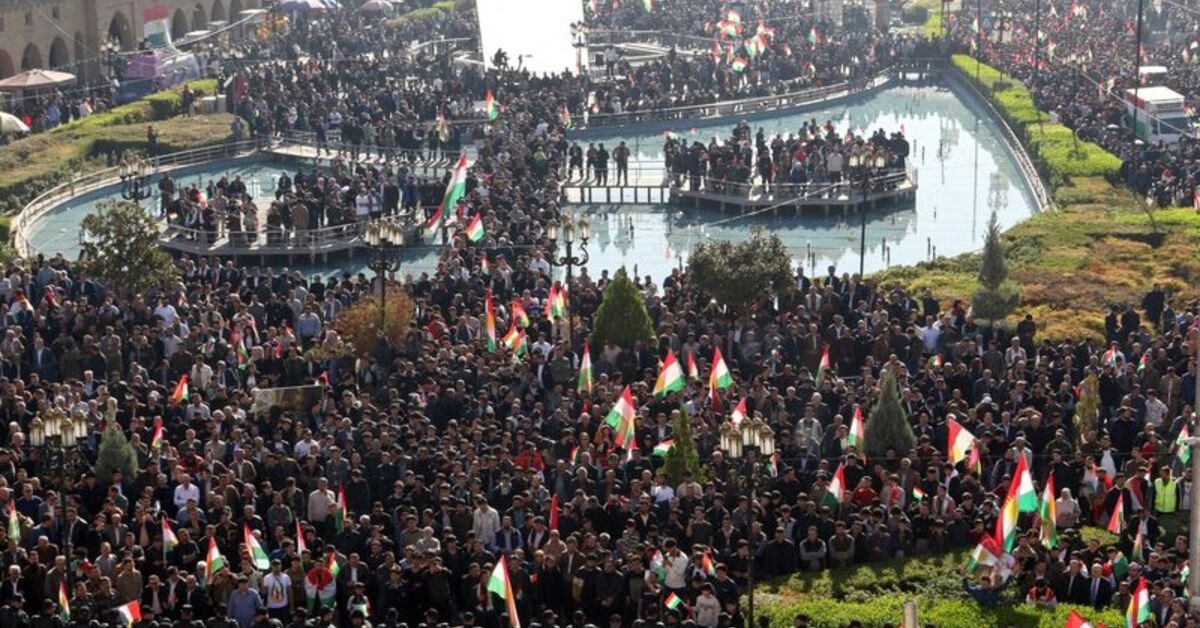
Thousands of demonstrators in the semi-autonomous Kurdistan region of Iraq protested against federal efforts to seize oil fields and secure international borders under Prime Minister Ali al-Zaidi.
 🕌Middle East
Photo: Al-Monitor
Key points
- Thousands of Kurds protested in Duhok and Erbil against federal control.
- Iraq's highest court ruled Baghdad can deploy forces along all borders.
- Prime Minister Zaidi ordered the federal oil ministry to manage certain Kurdish-controlled fields.
Thousands of demonstrators took to the streets across Iraq's semi-autonomous Kurdistan region on Thursday to protest Prime Minister Ali al-Zaidi's administration over directives aimed at establishing federal control over regional oil fields and international borders. The mobilization follows a judicial ruling by Iraq's highest court authorizing the deployment of federal forces along all international boundaries, including those encompassing the Kurdistan region. Protesters in cities such as Duhok and Erbil rejected the measures, displaying banners and voicing defiance against what they termed an unconstitutional overreach by Baghdad.
The directives represent the second major confrontation initiated by the 41-year-old prime minister within a week, following a separate standoff involving an Iran-aligned Shi'ite militia accused of operating illicit oil smuggling networks south of Baghdad. Prime Minister Zaidi has instructed the federal oil ministry to take charge of petroleum facilities currently managed by Kurdish security forces across four provinces outside the official regional boundaries. In response, the Kurdistan Regional Government issued a statement condemning the reliance on military language and threats while simultaneously expressing a willingness to cooperate with federal authorities on anti-corruption initiatives.
Relations between the central government in Baghdad and regional authorities have historically experienced severe strain over the distribution of revenues, territorial boundaries, and petroleum resources. While federal authorities previously used military force following a 2017 independence referendum, current tensions test the limits of executive authority for a leader who assumed office via a political compromise six months ago. Analysts note that successfully executing measures against deeply entrenched armed factions and regional authorities remains a substantial challenge.
The stakes
Prime Minister Zaidi gains greater state authority and momentum in curbing unauthorized resource extraction if the centralization measures succeed, whereas regional Kurdish authorities risk losing administrative autonomy and control over lucrative energy assets. Implementation could reshape the balance of power between Baghdad and armed factions across Iraq, potentially risking broader civil instability if negotiations fail.
Two readings
- Supporters view the prime minister's actions as a lawful, necessary campaign to enforce constitutional order, combat corruption, and eliminate illegal oil smuggling networks nationwide.
- Critics argue that unilateral military directives and judicial rulings undermine regional autonomy, threaten fragile ethnic peace, and rely on intimidation rather than dialogue.
Source Al-Monitor — al-monitor.com/originals/2026/11/iraqi-kurds-protest-against-baghda… ↗
Read next
 ✒️Opinion & Analysis
ICJ Rules Myanmar Military Committed Genocide Against Rohingya
The International Court of Justice has found Myanmar's military guilty of genocide against the Rohingya, a ruling that damages the international standing of both Aung San…
 🕯️Democracy & Rights
Chinese teachers face rising parental pressure over personal life choices
Chinese educators are encountering a surge in unreasonable demands from parents, including complaints regarding teachers' pregnancy and maternity leave.
 🛡️War & Security
Ukraine Restricts Media Coverage of Infrastructure Damage Amid Russian Strikes
President Volodymyr Zelenskyy has issued a decree prohibiting media outlets from reporting on the impact of Russian strikes against critical infrastructure and the status…
 🏮China & Taiwan
Beijing Reaffirms Reunification Stance Following Taiwan Local Election Results
China’s Taiwan Affairs Office declared that the island’s reunification with the mainland remains inevitable, despite recent shifts in Taiwan's local political landscape.
 🇪🇺Europe
US Air Force Repels Unauthorized Drone Incursion at RAF Lakenheath
U.S. security forces at a British air base successfully countered a group of unidentified drones, amid growing concerns over potential foreign state involvement.
 ⚖️Law & Policy
India Government Proposes 50% Increase in Parliamentary Seats and Women's Reservation
The Indian government plans to introduce legislation to expand the Lok Sabha to 850 seats and mandate a 33% reservation for women in legislative bodies.