Iraqi Kurdistan Protests Erupt Over Baghdad's Move to Seize Oil and Borders
Large-scale protests have broken out in Erbil following a federal government decree to centralize control over Kurdish oil operations and border crossings. The move, backed by the Supreme Court, marks a significant escalation in the long-standing power struggle between Baghdad and the autonomous region.
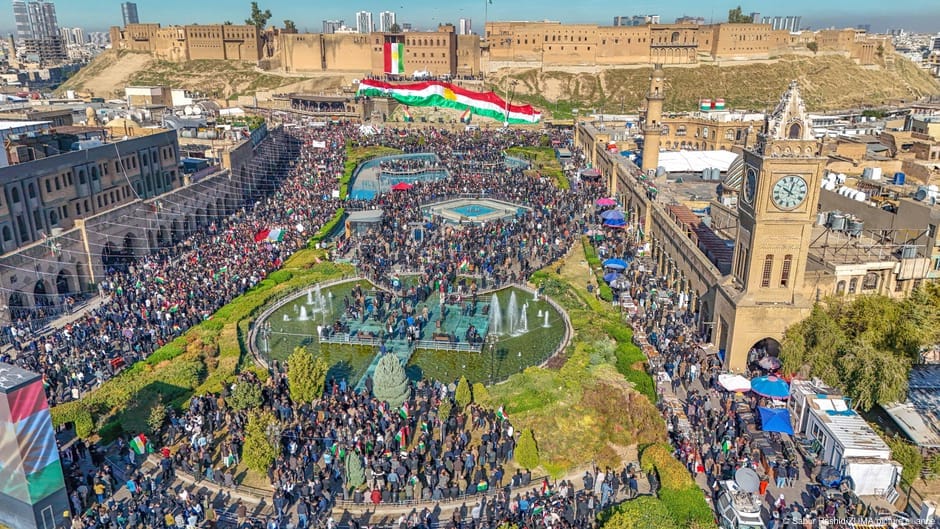 🕌Middle East
Photo: DW World
Key points
- Baghdad moves to seize control of Kurdish oil fields and border crossings.
- Iraq's Supreme Court limits KRG authority to pre-2003 territorial boundaries.
- Rival Kurdish parties unite in protest against central government encroachment.
Mass demonstrations took place in Erbil and surrounding cities on Thursday as Kurdish citizens rallied against a federal government plan to seize control of regional oil infrastructure and border crossings. The protests, which unified rival Kurdish political factions, were a direct response to a directive from Prime Minister Ali al-Zaidi aimed at curbing oil smuggling and asserting central authority over regional assets.
The federal government’s move, which received validation from Iraq’s Federal Supreme Court on Wednesday, mandates that the Ministry of Oil now oversee all exports and management of oil fields in the provinces of Kirkuk, Diyala, Salahuddin, and Nineveh. Additionally, the court ruled that the Kurdistan Regional Government's (KRG) jurisdictional authority is legally restricted to the borders that existed prior to the 2003 U.S.-led invasion, effectively stripping the KRG of control over disputed territories reclaimed from Islamic State forces.
Kurdish leadership has condemned the decision as a constitutional violation and a regression toward a centralized, autocratic regime. Prime Minister Masrour Barzani labeled the measures unacceptable, while the KRG cabinet argued the decree ignores the political realities established since the 2005 constitution. Prime Minister al-Zaidi, however, maintains that these actions are essential to exercising Iraq's independent national will and restoring federal oversight.
The stakes
The centralization of oil and border management threatens to destabilize the fragile power-sharing arrangement between Baghdad and Erbil, potentially triggering a fiscal crisis for the Kurdish region. If implemented, the shift would strip the KRG of its primary revenue streams and autonomy, effectively reversing decades of Kurdish self-governance and likely fueling further civil unrest in the north.
Two readings
- Supporters of the federal government argue that centralizing control is necessary to combat corruption, stop illicit oil smuggling, and uphold the rule of law across all Iraqi provinces.
- Critics view the move as a politically motivated power grab designed to dismantle Kurdish autonomy and undermine the constitutional rights of the region.
Source DW World — dw.com/en/protests-in-iraqi-kurdistan-at-plans-for-government-in-ba… ↗
Read next
 ✒️Opinion & Analysis
ICJ Rules Myanmar Military Committed Genocide Against Rohingya
The International Court of Justice has found Myanmar's military guilty of genocide against the Rohingya, a ruling that damages the international standing of both Aung San…
 🕯️Democracy & Rights
Chinese teachers face rising parental pressure over personal life choices
Chinese educators are encountering a surge in unreasonable demands from parents, including complaints regarding teachers' pregnancy and maternity leave.
 🛡️War & Security
Ukraine Restricts Media Coverage of Infrastructure Damage Amid Russian Strikes
President Volodymyr Zelenskyy has issued a decree prohibiting media outlets from reporting on the impact of Russian strikes against critical infrastructure and the status…
 🏮China & Taiwan
Beijing Reaffirms Reunification Stance Following Taiwan Local Election Results
China’s Taiwan Affairs Office declared that the island’s reunification with the mainland remains inevitable, despite recent shifts in Taiwan's local political landscape.
 🇪🇺Europe
US Air Force Repels Unauthorized Drone Incursion at RAF Lakenheath
U.S. security forces at a British air base successfully countered a group of unidentified drones, amid growing concerns over potential foreign state involvement.
 ⚖️Law & Policy
India Government Proposes 50% Increase in Parliamentary Seats and Women's Reservation
The Indian government plans to introduce legislation to expand the Lok Sabha to 850 seats and mandate a 33% reservation for women in legislative bodies.