Pakistan Minister in India Demands Evidence for Terror Talks
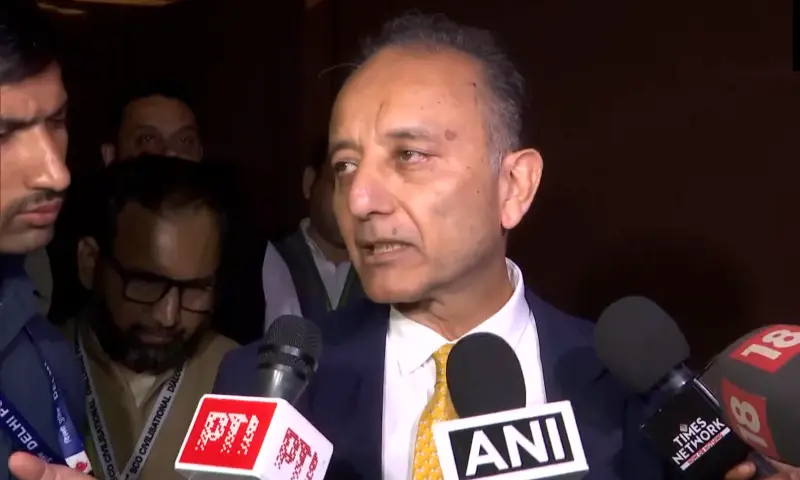
Pakistani Federal Minister Musadik Malik, visiting New Delhi for the SCO Civilisational Dialogue Forum, stated that any bilateral dialogue with India on terrorism must be strictly evidence-based. He declined to discuss the Indus Waters Treaty, noting he was not invited for bilateral negotiations on that specific issue.
 🚢Sanctions & Trade
Photo: Dawn
Key points
- Musadik Malik is the first Pakistani minister to visit India since May 2023.
- Malik stated that terrorism talks must be based on evidence and require a specific bilateral invitation.
- The Indus Waters Treaty remains a contentious issue after India's unilateral suspension in 2024.
- The Permanent Court of Arbitration ruled in August 2024 that the IWT remains fully in force.
Federal Minister Musadik Malik arrived in New Delhi on Sunday, marking the first high-level Pakistani visit since former foreign minister Bilawal Bhutto-Zardari attended an SCO meeting in May 2023. During his three-day trip to the SCO Civilisational Dialogue Forum, Malik addressed Indian media, asserting that any future discussions on cross-border terrorism between the two nations must be grounded in verifiable evidence rather than political rhetoric.
Malik emphasized that Pakistan has consistently offered to engage in dialogue to resolve outstanding disputes, including water management. However, he drew a sharp distinction between the multilateral forum he was attending and bilateral negotiations. When pressed on the Indus Waters Treaty (IWT), the minister stated that he was a guest at a cultural and civilizational event, not a venue for bilateral political demands. He noted that if New Delhi wished to discuss the treaty or terrorism bilaterally, they would need to issue a specific invitation for such talks.
The diplomatic engagement occurs against a backdrop of heightened tensions following a four-day military confrontation in May 2025. That conflict was triggered by an attack on tourists in Pahalgam, which India attributed to Pakistan without presenting conclusive evidence, a claim Islamabad strongly denied. India had previously suspended the IWT in April 2024, a move Pakistan labeled an act of war and a violation of international law. The Permanent Court of Arbitration ruled in August 2024 that the treaty remained fully in force, rejecting India's justification for its suspension.
The stakes
If bilateral channels remain closed, the risk of further escalatory rhetoric and unilateral actions, particularly regarding water resources, persists. A return to evidence-based dialogue could de-escalate tensions, but the current diplomatic posture suggests both sides are prioritizing legal and multilateral frameworks over direct negotiation. The outcome hinges on whether India issues the specific bilateral invitation Malik referenced.
Two readings
- Supporters of the Pakistani position view this as a principled stand against unfounded accusations, insisting that security and water disputes be resolved through legal and factual mechanisms rather than political pressure.
- Critics may argue that the insistence on 'evidence' and the refusal to engage bilaterally at the current moment serves as a diplomatic stalling tactic, avoiding immediate accountability for the Pahalgam attack and the suspension of the Indus Waters Treaty.
Source Dawn — dawn.com/news/2046343/any-talks-with-india-on-terrorism-must-be-evi… ↗
Read next
 ✒️Opinion & Analysis
ICJ Rules Myanmar Military Committed Genocide Against Rohingya
The International Court of Justice has found Myanmar's military guilty of genocide against the Rohingya, a ruling that damages the international standing of both Aung San…
 🕯️Democracy & Rights
Chinese teachers face rising parental pressure over personal life choices
Chinese educators are encountering a surge in unreasonable demands from parents, including complaints regarding teachers' pregnancy and maternity leave.
 🛡️War & Security
Ukraine Restricts Media Coverage of Infrastructure Damage Amid Russian Strikes
President Volodymyr Zelenskyy has issued a decree prohibiting media outlets from reporting on the impact of Russian strikes against critical infrastructure and the status…
 🏮China & Taiwan
Beijing Reaffirms Reunification Stance Following Taiwan Local Election Results
China’s Taiwan Affairs Office declared that the island’s reunification with the mainland remains inevitable, despite recent shifts in Taiwan's local political landscape.
 🇪🇺Europe
US Air Force Repels Unauthorized Drone Incursion at RAF Lakenheath
U.S. security forces at a British air base successfully countered a group of unidentified drones, amid growing concerns over potential foreign state involvement.
 ⚖️Law & Policy
India Government Proposes 50% Increase in Parliamentary Seats and Women's Reservation
The Indian government plans to introduce legislation to expand the Lok Sabha to 850 seats and mandate a 33% reservation for women in legislative bodies.