South African Canola Sector Achieves Net Exporter Status
South Africa's canola industry has transformed into a net exporter, driven by rising domestic demand, increased processing capacity, and expanded commercial plantings.
 🚢Sanctions & Trade
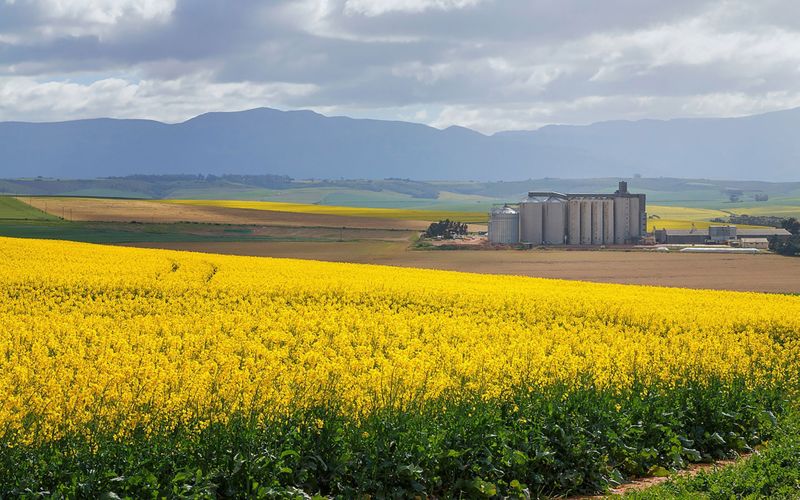
Photo: Daily Maverick
Key points
- Canola area expands to nearly 198,000 hectares by 2026-27.
- South Africa expects a record canola harvest of 368,270 tonnes.
- Government targets 2.5 million hectares of land for commercial agricultural use.
South Africa’s canola industry has transitioned into a net exporter, mirroring the growth seen in other agricultural sectors like soybeans and citrus fruits, according to agricultural authorities. Commercial plantings of canola have expanded significantly since 1998, with the cultivated area projected to reach 197,890 hectares by the 2026-27 season, up from initial trials on 17,000 hectares.
Driven by rising domestic demand for oils and oilcake, the sector expects a record harvest of 368,270 tonnes, marking a 20% year-on-year increase. The expansion is largely concentrated in the Western Cape, where some farmers have shifted from wheat to canola due to higher profitability. South Africa has already shipped canola to international destinations including Germany and Belgium in recent years.
Agricultural officials emphasize that this model of investment, processing capacity, and export expansion should serve as a blueprint for the broader agricultural sector. Attention is now turning toward the productive utilization of 2.5 million hectares of former homelands and newly released government land, a process overseen by the Department of Agriculture and the Department of Land Reform and Rural Development.
The stakes
If the government successfully integrates the newly released land into commercial production through partnerships with agribusinesses, South Africa could replicate its canola success across other crops and livestock, boosting exports to the Middle East, Asia, Europe, and the Americas while creating shared economic prosperity.
Two readings
- Supporters view: Proponents argue that the commodity-led growth proves that strategic processing investments and consistent implementation of the Agriculture and Agro-processing Master Plan can drive sustainable rural development and export diversification.
- Critics view: Skeptics point out that land reform and the release of state-owned parcels remain slow, warning that without targeted state support for smallholder farmers, new land allocations may fail to achieve commercial viability.
Source Daily Maverick — dailymaverick.co.za/article/2026-11-09-from-imports-to-exports-cano… ↗
Read next
 ✒️Opinion & Analysis
ICJ Rules Myanmar Military Committed Genocide Against Rohingya
The International Court of Justice has found Myanmar's military guilty of genocide against the Rohingya, a ruling that damages the international standing of both Aung San…
 🕯️Democracy & Rights
Chinese teachers face rising parental pressure over personal life choices
Chinese educators are encountering a surge in unreasonable demands from parents, including complaints regarding teachers' pregnancy and maternity leave.
 🛡️War & Security
Ukraine Restricts Media Coverage of Infrastructure Damage Amid Russian Strikes
President Volodymyr Zelenskyy has issued a decree prohibiting media outlets from reporting on the impact of Russian strikes against critical infrastructure and the status…
 🏮China & Taiwan
Beijing Reaffirms Reunification Stance Following Taiwan Local Election Results
China’s Taiwan Affairs Office declared that the island’s reunification with the mainland remains inevitable, despite recent shifts in Taiwan's local political landscape.
 🇪🇺Europe
US Air Force Repels Unauthorized Drone Incursion at RAF Lakenheath
U.S. security forces at a British air base successfully countered a group of unidentified drones, amid growing concerns over potential foreign state involvement.
 ⚖️Law & Policy
India Government Proposes 50% Increase in Parliamentary Seats and Women's Reservation
The Indian government plans to introduce legislation to expand the Lok Sabha to 850 seats and mandate a 33% reservation for women in legislative bodies.