British Minister Miliband Frames Fossil Fuel Dependence as National Security Threat
British minister Ed Miliband warned at a summit in Türkiye that relying on fossil fuels creates major national security risks due to geopolitical market volatility. He called on global leaders to accelerate the adoption of clean energy electrification to safeguard stability.
 🇬🇧UK & Ireland
Photo: Anadolu
Key points
- Ed Miliband declared fossil fuel reliance a major national security vulnerability during a speech in Antalya.
- The British official pointed to past economic recessions and geopolitical crises as evidence of energy market instability.
- Miliband urged international ministers to prioritize clean energy electrification in the run-up to COP31.
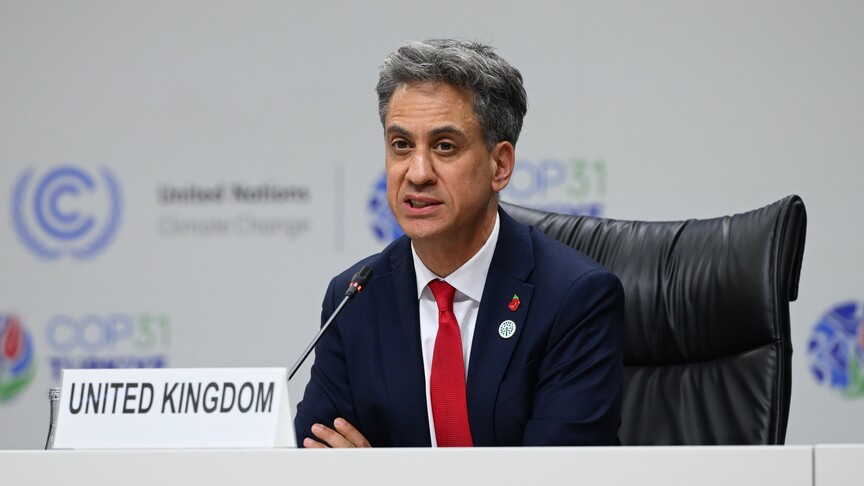
British foreign minister Ed Miliband stated at a summit in Antalya, Türkiye, that reliance on fossil fuels poses a direct threat to national security, calling on global leaders to accelerate the transition toward clean energy electrification.
Speaking at the Clean Energy Transition & Electrification Summit in the context of the COP31 climate conference, Miliband cited geopolitical conflicts—including wars involving Iran and the conflict between Russia and Ukraine—as evidence of economic instability caused by volatile energy markets. He noted that fossil-fuel crises have triggered half of the economic recessions experienced by Britain since the 1970s, adding that even major oil producers like the United States remain vulnerable to energy-driven fallout.
Miliband commended the Turkish presidency for positioning clean energy at the center of COP31 discussions. He argued that foreign ministers and prime ministers must view climate disruption through a defense lens, highlighting its direct impact on food supplies, critical infrastructure, and population displacement.
The stakes
Proponents of the shift seek to insulate national economies from external energy shocks and diminish vulnerability to global market swings, while legacy energy sectors and fossil-dependent industries face mounting pressure to adjust quickly to altered policy priorities and funding flows.
Two readings
- Supporters contend that framing renewable energy as a core component of national security builds a pragmatic foundation to accelerate grid modernization and decrease geopolitical exposure.
- Critics argue that treating the energy transition as an emergency security mandate risks prioritizing aggressive regulatory targets over immediate market stability and consumer affordability.
Source Anadolu — aa.com.tr/en/world/uk-foreign-secretary-says-reliance-on-fossil-fue… ↗
Read next
 ✒️Opinion & Analysis
ICJ Rules Myanmar Military Committed Genocide Against Rohingya
The International Court of Justice has found Myanmar's military guilty of genocide against the Rohingya, a ruling that damages the international standing of both Aung San…
 🕯️Democracy & Rights
Chinese teachers face rising parental pressure over personal life choices
Chinese educators are encountering a surge in unreasonable demands from parents, including complaints regarding teachers' pregnancy and maternity leave.
 🛡️War & Security
Ukraine Restricts Media Coverage of Infrastructure Damage Amid Russian Strikes
President Volodymyr Zelenskyy has issued a decree prohibiting media outlets from reporting on the impact of Russian strikes against critical infrastructure and the status…
 🏮China & Taiwan
Beijing Reaffirms Reunification Stance Following Taiwan Local Election Results
China’s Taiwan Affairs Office declared that the island’s reunification with the mainland remains inevitable, despite recent shifts in Taiwan's local political landscape.
 🇪🇺Europe
US Air Force Repels Unauthorized Drone Incursion at RAF Lakenheath
U.S. security forces at a British air base successfully countered a group of unidentified drones, amid growing concerns over potential foreign state involvement.
 ⚖️Law & Policy
India Government Proposes 50% Increase in Parliamentary Seats and Women's Reservation
The Indian government plans to introduce legislation to expand the Lok Sabha to 850 seats and mandate a 33% reservation for women in legislative bodies.