Pakistan Government and PPP Leaders Consult on Legislative Agenda
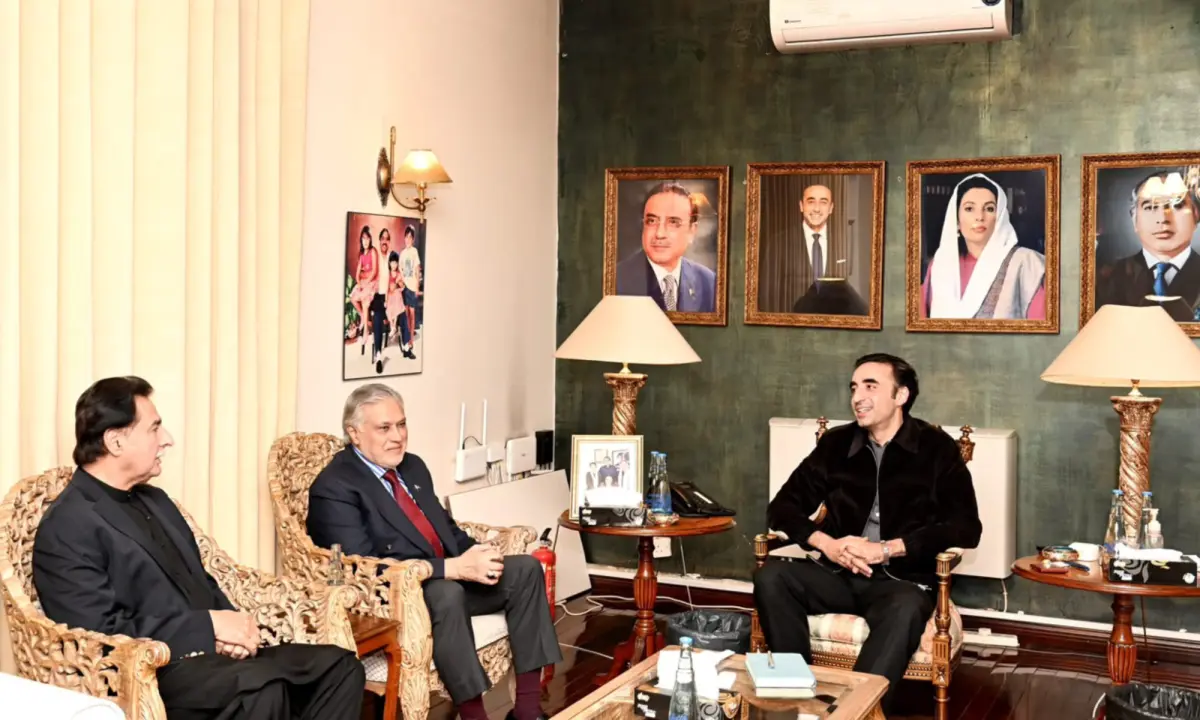
Deputy Prime Minister Ishaq Dar and PPP Chairman Bilawal Bhutto-Zardari met to discuss upcoming parliamentary sessions and address internal political tensions.
 🇺🇸US Politics
Photo: Dawn
Key points
- Deputy PM Ishaq Dar and Bilawal Bhutto-Zardari discussed legislative priorities.
- PPP raised concerns regarding the treatment of JUI-F leader Maulana Fazlur Rehman.
- The meeting aimed to de-escalate tensions over proposals to create new provinces.
Deputy Prime Minister Ishaq Dar led a government delegation to meet with Pakistan Peoples Party (PPP) Chairman Bilawal Bhutto-Zardari at Zardari House in Islamabad this Saturday. The discussion focused on coordinating the upcoming parliamentary session and outlining potential legislative priorities for the coalition government.
The meeting included high-ranking officials, such as National Assembly Speaker Ayaz Sadiq and Parliamentary Affairs Minister Tariq Fazal Chaudhry. Beyond legislative scheduling, the dialogue addressed broader political friction, including concerns raised by the PPP regarding the recent treatment of Jamiat Ulema-i-Islam-Fazl (JUI-F) leader Maulana Fazlur Rehman and his family following a raid on his residence.
These consultations occur amid ongoing debates concerning the restructuring of provincial administrative units. The PPP has publicly opposed proposals to create new provinces, with Chairman Bhutto-Zardari warning that such changes, particularly in Sindh, could incite instability. This meeting serves as a follow-up to recent high-level talks between President Asif Ali Zardari and Prime Minister Shehbaz Sharif, aimed at de-escalating public disagreements within the ruling coalition.
The stakes
The stability of the current coalition government rests on the ability of the PML-N and PPP to align on sensitive constitutional and administrative reforms. If the parties fail to reach a consensus, the government risks legislative gridlock and the potential alienation of key political allies, which could further complicate the passage of the 27th Amendment and other critical policy objectives.
Two readings
- Supporters view these meetings as essential for maintaining democratic continuity and ensuring that the coalition remains unified during a period of significant economic and administrative pressure.
- Critics argue that the lack of internal consultation and the government's push for administrative restructuring threaten regional stability and reflect a failure to address the grievances of coalition partners.
Source Dawn — dawn.com/news/2047689/govt-ppp-discuss-upcoming-parliament-session-… ↗
Read next
 ✒️Opinion & Analysis
ICJ Rules Myanmar Military Committed Genocide Against Rohingya
The International Court of Justice has found Myanmar's military guilty of genocide against the Rohingya, a ruling that damages the international standing of both Aung San…
 🕯️Democracy & Rights
Chinese teachers face rising parental pressure over personal life choices
Chinese educators are encountering a surge in unreasonable demands from parents, including complaints regarding teachers' pregnancy and maternity leave.
 🛡️War & Security
Ukraine Restricts Media Coverage of Infrastructure Damage Amid Russian Strikes
President Volodymyr Zelenskyy has issued a decree prohibiting media outlets from reporting on the impact of Russian strikes against critical infrastructure and the status…
 🏮China & Taiwan
Beijing Reaffirms Reunification Stance Following Taiwan Local Election Results
China’s Taiwan Affairs Office declared that the island’s reunification with the mainland remains inevitable, despite recent shifts in Taiwan's local political landscape.
 🇪🇺Europe
US Air Force Repels Unauthorized Drone Incursion at RAF Lakenheath
U.S. security forces at a British air base successfully countered a group of unidentified drones, amid growing concerns over potential foreign state involvement.
 ⚖️Law & Policy
India Government Proposes 50% Increase in Parliamentary Seats and Women's Reservation
The Indian government plans to introduce legislation to expand the Lok Sabha to 850 seats and mandate a 33% reservation for women in legislative bodies.